
Absolute Humidity (φ)
air-Qs with a sensor for Absolute Humidity


Definition: Absolute humidity
The content of gaseous water in the air is commonly referred to as humidity. The gaseous water, water vapor, is invisible, since it is not the clouds of tiny droplets that form clearly visible fog. How much water vapor the air can hold strongly depends on the local temperature.
To precisely determine humidity in a room, a distinction must be made between relative, maximum and absolute humidity. Absolute humidity describes water vapor density, i.e. the mass of water vapor contained in a defined volume of air. It is usually expressed in g/m³ and ranges between zero and the maximum water vapor content that the air can reach at a given volume and a certain temperature. Relative humidity, by contrast, describes the ratio between water vapor density and maximum humidity.
The dew point also plays an important role in this context. It describes the temperature below which water vapor condenses into dew or fog. Since air can hold less water vapor at lower temperatures, the excess portion becomes liquid once the dew point is reached.
Limit values for absolute humidity
No limit values have yet been established for indoor absolute humidity.
The greatest risk in rooms with excessive humidity is probably mold growth. The threshold for this is a relative humidity of 60 %. In a room with a temperature of 20 °C, this corresponds to an absolute humidity of 10.4 g/m³.
Varying temperatures within the room are particularly problematic. Depending on insulation, a relative humidity of just 50 % may be enough to contribute to mold growth near colder exterior walls once the dew point is undercut there. The building materials used also play a significant role here, as they have a major influence on how quickly water vapor diffuses.
Designation | Absolute humidity limit values |
general recommendation minimum value | 6.9 g/m³ |
general recommendation maximum value | 10.4 g/m³ |
Effects of humidity that is too high or too low
Health impairments related to the water vapor content of the air strongly depend on relative humidity. If it is too low, the immune system is weakened. It also leads to dryness of the mucous membranes, skin irritation, and reduced respiratory performance. The risk of overly dry air increases especially in winter. Cold outdoor air can hold only a little water vapor. When it enters indoor spaces and is warmed there, for example by heating, relative humidity decreases while absolute humidity remains constant.
Excessive humidity can not only cause discomfort, strain on the circulatory system, and impaired productivity. It also increases the likelihood of mold forming indoors. If its spores enter the body via the respiratory tract, this can lead to complaints such as conjunctivitis, gastrointestinal problems, joint pain, asthma or migraines.
Dust mites also multiply more readily at a high relative humidity of 60 % or above, which can be particularly problematic for allergy sufferers.
Formation of humidity
At water surfaces, individual water molecules pass into the air using their thermal energy. Water molecules in the air also return into the water surface if they encounter it. The more water molecules there are in the air, the more often this happens. At a relative humidity of 100 %, exactly as many molecules return into the water surface as leave it. The air is saturated. If the air is warmed, however, this equilibrium only occurs with a higher number of water molecules in the air. Its capacity to hold water has increased.
Since relative humidity depends very strongly on temperature, because the air's capacity to hold water is temperature-dependent, it is difficult to say whether actively humidifying the air is efficient. If, for example, you cover a radiator with a damp cloth, the temperature in the room decreases because the heating output is reduced. This decrease in temperature alone already leads to an increase in relative humidity. Absolute humidity, however, does not change through the temperature change alone, since if the air does not absorb any moisture, the mass of water per cubic meter of air does not increase. Only once absolute humidity actually increases can one say with certainty that the damp cloth is contributing to an increase in humidity.
Sensor used:
Absolute humidity is measured in the air-Q by a relative humidity sensor with very high accuracy. Absolute humidity is derived from the measured value. The air-Q responds somewhat more slowly to changes in humidity than a sensor with completely open exposure to the air.
Measuring humidity
As an air analyzer and measuring device, the air-Q also has a sensor that can measure absolute humidity and other indoor air parameters in real time. Incidentally, absolute humidity is also referred to as water vapor density.
Many facts about the air-Q's technology can be found here. You can order the air-Q in the online shop.
Articles about Absolute Humidity

Humidity in Spring: Why It Still Matters
Especially in spring, humidity often rises unnoticed, which can promote mold formation. This can become a problem especially in the bedroom, living room, and basement. Devices like the air-Q help make relevant values visible and create an ideal indoor climate.
Learn more
Humidity in Your Home: Everything You Need to Know
Find out how to optimally regulate humidity in your home. Discover tips for achieving the ideal indoor humidity and measures to improve humidity in your living space. Get valuable advice on lowering and raising moisture levels for a healthy living climate.
Learn more
Absolute Humidity: Definition, Causes & Effects
Absolute humidity describes how much water vapor is present in the air. This measurement is influenced by our breathing, plants, cooking, or showering. Since absolute humidity plays an important role in human well-being, we take a closer look at this metric.
Learn more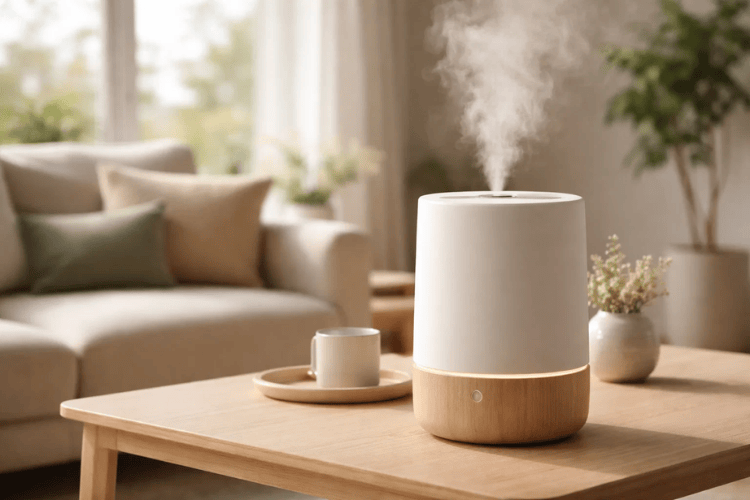
Minimum Humidity 40 Percent: Establishing Healthy Humidity Levels
Dry air is a particular problem during the winter heating season: on one hand, too-low room humidity worsens the important sense of comfort. On the other hand, it leads to an increased risk of infection – for example from flu viruses. That's why a trade association launched the Minimum Humidity 40 Percent campaign.
Learn more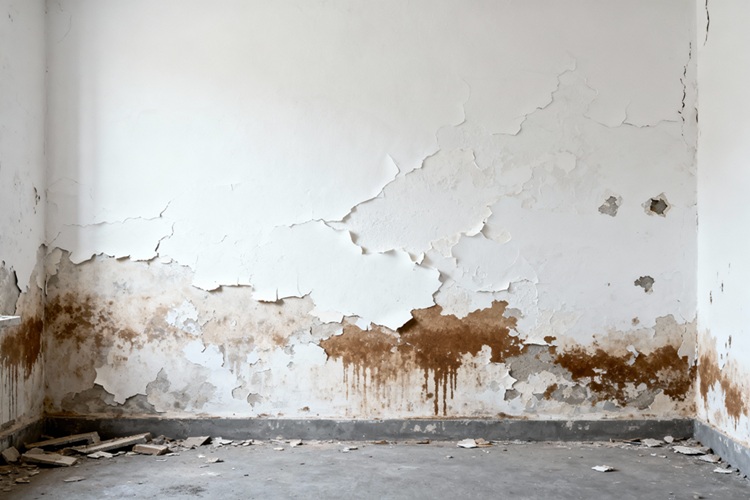
Wet Wall in the House - Causes, Consequences, and What Helps Now
Is your wall wet or damp and you're wondering what to do? In this guide, you'll learn how to correctly interpret signs of moisture in a wall, which causes are likely, what risks threaten health and building structure, and which measures let you get wet walls permanently under control.
Learn more
How Do Natural Disasters Affect Air Quality? Focus: Flooding.
Sustained rain causes the water levels of the Moselle, Rhine, Oder, Danube, Elbe, or other rivers to rise well above average. Flooding threatens the surrounding areas. Natural disasters like floods bring, besides economic damage, significant effects on air quality. We take a look at some of the key effects.
Learn moreCalculators
More measured values / sensors