
Air Pressure (p)
air-Qs with a sensor for Air Pressure
Description:
Air pressure refers to the compression, i.e. the densification, of air.
Changes in air pressure are caused by various complex atmospheric processes, the largest contributor being the warming of air masses through solar radiation. The Earth's rotation also has a decisive influence. Air pressure also decreases measurably as altitude above sea level increases.
At sea level, a mean air pressure of 101325 Pa (Pascal) is assumed. This standard value can also be given as 1 bar.
Limit values for air pressure:
Researchers assume that air pressure fluctuations with an amplitude between 0.3 and 0.5 hPa have effects on blood pressure, circulation and concentration.
Occupational health and safety measures apply with regard to negative or positive pressure. When the standard value is undercut, a person is exposed to negative pressure. If the value falls below 0.73 hPa, the type and duration of the activity must be adjusted for health reasons.
Positive pressure can already cause health impairments at a pressure increase of 0.1 hPa above the standard value. Workers under 18 and over 50 years of age may therefore not be employed under these conditions, or only with a special exemption permit. Employment under positive pressure is likewise prohibited for pregnant women, breastfeeding mothers, and people with acute or chronic illnesses. At a positive pressure of over 3.6 hPa, work may only take place with a government exemption permit.
Designation | Air pressure limit values |
no limit values defined | - |
Effects of pressure that is too high or too low:
Air pressure alone is not responsible for health and well-being, but rather as one part of the overall atmospheric environmental conditions. In this context, scientists distinguish three levels of physiological and psychological weather influence.
All people fall at least into the category of "weather-reactive", meaning they are, for example, in a better mood in pleasant temperatures and sunshine than in rain and cold.
People whose nervous system reacts to fluctuations in air pressure and temperature are considered "weather-sensitive". As a result, their general stimulus threshold is lowered while pain perception is heightened. Typical symptoms include headaches, fatigue, lethargy, exhaustion, and difficulty concentrating or sleeping.
The term "weather-affected" is used when changes in weather worsen existing illnesses or cause old injuries (e.g. bone fractures) to hurt again. This applies especially to patients with chronic diseases of the respiratory or cardiovascular system, arteriosclerosis or rheumatism. People suffering from chronic pain, migraines or allergies also frequently experience a worsening of their symptoms during weather changes. Mental illnesses can also worsen in this context.
It should also be noted that as pressure increases, the gases contained in the air (especially nitrogen) are absorbed by the body in greater amounts.
Formation:
Air pressure arises because air – driven by gravity – tends to flow toward the Earth's center but is held back by the Earth's surface.
Changes in air pressure result from the constant movement of air masses in the atmosphere. A high-pressure area is said to occur when colder air masses push over warmer ones, thereby increasing the pressure of the lower air masses. The air warmed by the higher pressure expands and escapes. To replace it, air flows in from higher layers and warms up in turn.
When warm air masses rise and disperse in the atmosphere, air pressure at ground level decreases and a low-pressure area forms. The formation of a low-pressure area is often accompanied by a sharp drop in pressure, which can cause health problems for weather-affected and weather-sensitive people.
Sensor used:
Air pressure is measured in the air-Q by a high-precision, high-resolution sensor. This samples the air pressure more than 30 times per second. This means the sensor is even able to detect the minimal changes in air pressure caused by opening and closing windows and doors.
Measuring air pressure:
The air-Q air analyzer can measure air pressure in real time and comprehensively analyze indoor air and air quality by measuring a total of 14 substances and substance groups (pollutants such as carbon monoxide). The device can be ordered here.
Articles about Air Pressure
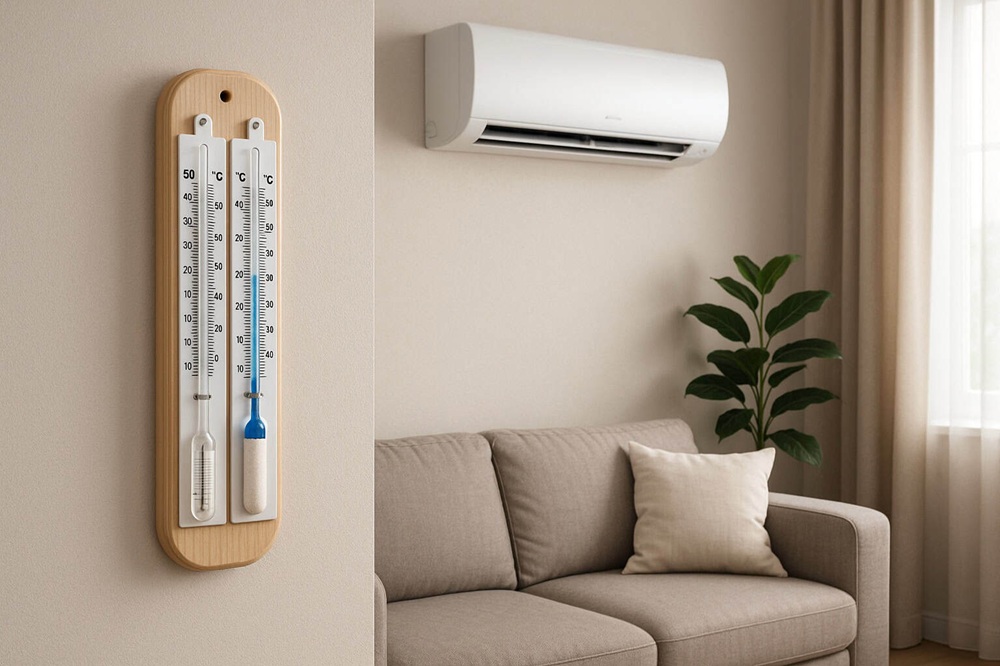
Wet-Bulb Temperature: A Comprehensive Guide
Discover the significance of wet-bulb temperature and its role in climate control and weather forecasting. Learn how it's measured, its practical applications in agriculture, construction, and air conditioning, and how to calculate the cooling limit temperature to optimize the efficiency of cooling systems.
Learn more
Measuring Infrasound: Causes, Effects, and Why Measurement Can Make Sense
Infrasound is caused by both natural sources and technical systems. Although it's often inaudible, it can be perceived as burdensome. Learn what effects infrasound can have, how it's assessed, and how the air-Q supports measurement and analysis.
Learn more
Home Assistant Weather Station – Smart Weather Data for Your Smart Home | air-Q
A smart weather station makes your smart home truly intelligent. Combined with Home Assistant, temperature, wind, and rain become valuable data for automations, such as for awnings, shutters, or heating. This article shows you the great potential of weather stations.
Learn more
Radon Dosimeter vs. Real-Time Radon Measurement: Benefits, Drawbacks & Challenges
Radon is an invisible health risk: both in the workplace and in your own home. But how is the radioactive gas measured, and why is this so important? We take a look at the importance of radon measurement, the differences between active and passive measurement methods, and their pros and cons.
Learn more
Why Should You Measure Air Quality in the Office?
Air quality in offices is crucial for the health and well-being of employees. It's therefore important to monitor and improve indoor air. We look at reasons for measuring it and introduce the air-Q office guard device, which helps companies optimize air quality in their premises.
Learn more
air-Q Radon: Your Smart Air Analyzer for Reliable Radon Measurements
Radon releases radioactive particles (so-called alpha radiation) as it decays. This is the leading cause of lung cancer in non-smokers! Our new air-Q Radon monitor tracks the dangerous noble gas in real time, checks for other pollutant sources in your indoor spaces, and gives you tips for optimal room air. Here it is.
Learn moreCalculators
More measured values / sensors