
Dew Point (Td)
air-Qs with a sensor for Dew Point
Description:
The dew point (Td – d stands for "dew point") is the temperature below which water vapor in the air condenses into water. At this temperature point, the air is completely saturated with water, i.e. the relative humidity is 100%, meaning the air has reached its maximum capacity for absorbing water.
The warmer the air, the more water vapor it can hold. For the dew point, this means: the more water vapor present in the air, the higher the dew point. The dew point and relative humidity are thus directly related and can each be calculated.
There are two different ways to determine the dew point. In the direct method, measurement is carried out using a so-called chilled-mirror hygrometer, which determines the dew point from the changing optical characteristics and reflective behavior of the mirror.
In the indirect method, on the other hand, the absolute humidity is determined using the room temperature and relative humidity. This can then be used to calculate the temperature at which the humidity will reach a saturation level of 100%.
Limit Values for the Dew Point:
There are no official limit values for the dew point. Recommendations for relative humidity, however, directly imply corresponding dew points. At room temperature, the recommended lower limit for the dew point is approx. 9°C – below this, the air would be perceived as too dry. The upper limit for the dew point is approx. 15°C – above this, the air would be perceived as too muggy.
Designation | Dew Point Limit Values |
General recommendation, minimum value | 9 °C |
General recommendation, maximum value | 15 °C |
Effects of a Dew Point That Is Too High or Too Low:
Temperatures can vary within a room. This becomes a problem if, for example, the dew point is undercut at cooler exterior walls. Water can then condense, and mold can form.
Formation of the Dew Point:
-
Sensor Used:
The dew point is calculated in the air-Q based on the Magnus formula (currently without factoring in air pressure). The values required for this are measured with high accuracy by the temperature sensor and the relative humidity sensor.
Measuring the Dew Point:
Alongside absolute and relative humidity, the air-Q air analyzer can also measure the dew point and other indoor air parameters in real time using one of its sensors. You can order the air quality monitor from the online shop.
Articles about Dew Point

Dew Point in Spring and Summer: Why Ventilating Suddenly Causes Moisture
Moisture indoors is also an issue in spring and summer. The dew point explains why ventilating sometimes brings additional moisture. The air-Q measures temperature and humidity, detects critical conditions, and supports data-based protection against condensation and mold formation.
Learn more
Musty Smell in Your Home Without Visible Mold? – Here's What You Should Do Now!
Does your home smell musty, fungal, or earthy, but you can't see any mold? A hidden mold infestation could still be the cause of the smell. We answer the most important questions about possible mold growth indoors and give tips on how to prevent a mold outbreak.
Learn more
air-Q Tests: The Effects of Air Conditioning in the Office
Heat drives away concentration. What brings relief in the office on hot days? Clearly, air conditioning! But how does circulating the air affect air quality? Does air conditioning pose a health risk? We checked this and analyzed the effects of the air conditioner in our own office with the air-Q.
Learn more
Winter Season = Mold in the Home?
Mold in the home is harmful to health. Often, however, the danger isn't immediately visible to the naked eye. Nevertheless, mold spores in the air negatively affect health and ideally shouldn't be allowed to form in the first place. We explain how you can detect, and even prevent, possible mold infestation based on air components.
Learn more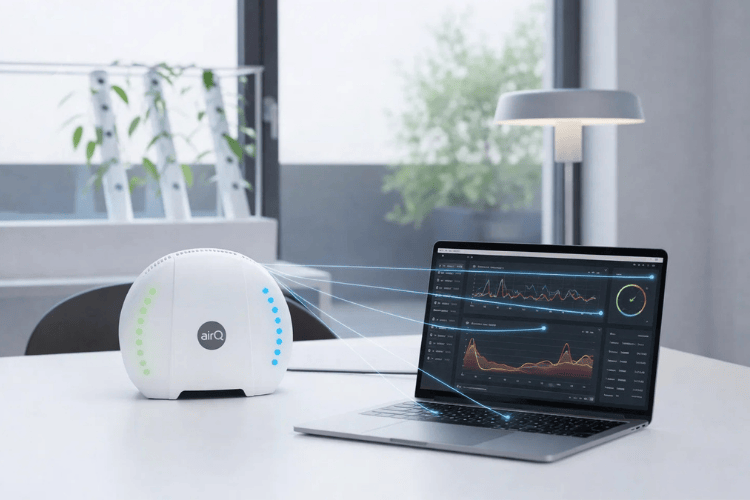
Temperature and Humidity Data Loggers: Why Precise Measurement Is Essential Today
Precise temperature measurement is more than just statistics. Whether for quality assurance in logistics or a healthy indoor climate in the office, a modern temperature and humidity data logger is essential. Find out in our guide what matters when choosing a temperature logger, and how real-time data makes the difference.
Learn more
What's New in Our air-Q App
Our air-Q app can now do even more. We introduce exciting new features that improve your user experience while offering more comfort and more precise monitoring of your room air. Experience the future of air quality measurement with the updated air-Q app – for a healthier and more pleasant indoor climate.
Learn moreCalculators
More measured values / sensors