Unit Converter (ppm - ppb - µg/m³ - mg/m³ - vol.%)
In air quality monitoring, there are various units of measurement for the gases involved. For example, it's common to measure carbon dioxide concentration in ppm (parts per million). The amount of particulate matter, on the other hand, is usually given in µg/m³ — since particulate matter particles can vary in size. To make measurements from different sources comparable, they need to be converted into the same unit. Our unit converter helps with that.
Unit Converter
Select the gas, source and target unit, as well as temperature and air pressure — the air-Q unit converter converts concentrations between ppm, ppb, µg/m³ and mg/m³.
Converting Units of Measurement for Gases
Whether you're an air quality expert or simply want to learn more about the air around you — our unit converter gives you a simple way to convert units. Temperature and air pressure are also taken into account. Below you'll find an overview of common units of measurement for the concentration of a gas or substance in the air.
ppm (Parts per Million): 1 ppm corresponds to 1 part per million parts of a gas.
ppb (Parts per Billion): 1 ppb corresponds to 1 part per billion parts of a gas.
mg/m³ (Milligrams per Cubic Meter): Indicates the mass of a substance per unit volume of air in mg/m³.
µg/m³ (Micrograms per Cubic Meter): Indicates the mass of a substance per unit volume of air in µg/m³.
Conversion formula: c [mg/m³] = c [ppm] · M / 24.45 – at 25 °C and 1013 hPa; M is the molar mass of the gas in g/mol (CO₂: 44.01; CO: 28.01; O₃: 48.00; NO₂: 46.01). For µg/m³ multiply the result by 1,000; for ppb multiply the ppm value by 1,000.
Example: 1,000 ppm CO₂ = 0.1 vol.-% = 1,000 · 44.01 / 24.45 ≈ 1,800 mg/m³ at 25 °C.
We continue to improve the air-Q Unit Converter and welcome your feature requests and suggestions.
Frequently asked questions about converting ppm
How do you convert ppm to mg/m³?
Multiply the ppm value by the molar mass of the gas and divide by the molar volume, 24.45 l/mol at 25 °C and 1013 hPa: c [mg/m³] = c [ppm] · M / 24.45. For CO₂ (M = 44.01 g/mol), 1,000 ppm therefore equals 1,000 · 44.01 / 24.45 ≈ 1,800 mg/m³. The calculator above also takes temperature and air pressure into account.
How do you convert ppm to percent?
1 percent equals 10,000 ppm, because ppm means parts per million and percent means parts per hundred. Divide the ppm value by 10,000: 1,000 ppm CO₂ is 0.1 percent by volume, 400 ppm is 0.04 percent. The other way round, multiply a percentage by 10,000 to get ppm.
1 ppm – how much is that in mg/l?
That depends on the medium. In water, 1 ppm ≈ 1 mg/l for dissolved substances, because a litre of water weighs about one kilogram. In air, ppm is a volume fraction: 1 ppm CO₂ corresponds to about 1.8 mg/m³ at 25 °C, i.e. 0.0018 mg/l. For other gases the factor changes with the molar mass.
What is the unit ppm?
ppm stands for parts per million. For gases in air it is a volume fraction: 1 ppm means one particle of the gas per one million particles of air, which is 0.0001 percent. Fresh outdoor air contains about 420 ppm CO₂; from roughly 1,000 ppm indoor air counts as stale. ppb (parts per billion) is one thousandth of a ppm.
No one has more sensors — measuring every air component.
- Hydrogen (H₂) — Hydrogen only occurs stably as molecular hydrogen (H₂) and is a colorless and odorless gas. It reacts quickly with oxygen (O₂) to form water, releasing energy in the process. H₂ is non-toxic but has flammable/explosive properties. Most of the hydrogen found on Earth is bound in water. It therefore occurs both in the Earth's atmosphere (here as water vapor) and in seas and other bodies of water, as well as in all living organisms. Without hydrogen, no transport of substances through the body would be possible.
- Volatile Organic Compounds (VOC) — VOCs (Volatile Organic Compounds) are organic, carbon-containing compounds that evaporate even at low temperatures. In many cases, VOCs are largely harmless to living organisms — despite affecting well-being. However, this group of substances also includes health-critical compounds such as formaldehyde. The abbreviation VOCs (Volatile Organic Compounds) refers to the group of carbon-containing substances that evaporate at low temperature or already occur in gaseous form at room temperature. These "volatile organic compounds" are further divided into two subgroups.
- Air Temperature (T) — Air temperature has a significant influence on the reaction rate of chemical processes and therefore on the human metabolic process. Measuring it is therefore worthwhile. Temperatures that are too high or too low can negatively affect both mental and physical health. The perceived temperature plays a major role for humans. This perceived ambient temperature, the room temperature, can differ from the air temperature that an air thermometer would measure.
- Dew Point (Td) — The dew point describes the temperature at which relative humidity reaches 100% and the water vapor present in the air would immediately begin to condense into water. The dew point (Td – d stands for "dew point") is the temperature below which water vapor in the air condenses into water. At this temperature point, the air is completely saturated with water, i.e. the relative humidity is 100%, meaning the air has reached its maximum capacity for absorbing water.
- Nitrogen Dioxide (NO₂) — Nitrogen dioxide (NO₂) belongs to the group of nitrogen oxides. It is a reddish-brown gas with a pungent odor similar to chlorine. NO₂ has a strongly irritating effect on the respiratory tract and promotes asthma. The reddish-brown gas is strongly oxidizing and readily soluble in water. Since it is also considered highly toxic and extremely corrosive, the utmost caution is required when handling NO₂.
- Hydrogen Sulfide (H₂S) — Hydrogen sulfide is a colorless, foul-smelling, and highly toxic gas that is combustible and readily flammable. It has the characteristic odor of rotten eggs and forms when proteins from sulfur-containing amino acids are broken down by putrefactive and sulfur bacteria. Hydrogen sulfide can be detected even in very small amounts by its smell of rotten eggs. This characteristic odor results from the decomposition of proteins from sulfur-containing amino acids by sulfur and putrefactive bacteria. It is also used to extract sulfur from petroleum.
- Sulfur Dioxide (SO₂) — Sulfur dioxide is a colorless irritant gas with a pungent smell and sour taste, perceptible to humans at a concentration between 0.8 and 4.0 mg/m³. The irritant gas with the chemical formula SO₂ is non-flammable and has the property of solidifying into a colorless liquid at -10 °C. It is also readily water-soluble (forming sulfurous acid) and is two to three times heavier than air.
- Oxygen (O₂) — Molecular oxygen (O₂) is a colorless and odorless gas that makes up 21% of the air. On the Earth's surface, oxygen is – by mass – the most abundant element. Almost all animal life needs oxygen to live. It is absorbed through breathing or, when dissolved in water, through absorption. At high concentrations, however, oxygen is toxic to most living organisms.
- Radon (Rn) — Radon is a noble gas whose decay releases radioactive particles (known as alpha radiation). Radon (Rn) is a chemical element in the noble gas main group and, at 9.73 mg/cm³, the heaviest of the elemental gases. It is chemically unreactive and, under normal conditions, colorless, odorless, and tasteless.
- Ozone (O₃) — Ozone (O₃) near the ground forms through the reaction of oxygen, nitrogen oxides, and volatile organic compounds under intense sunlight. Even slightly elevated concentrations cause strong irritation of the mucous membranes and respiratory tract. Ozone (O₃) is a colorless to slightly blue gas with a pungent, sharp to chlorine-like odor. The odor threshold for human perception of the gas is 40 µg/m³.
- Methane (CH₄) — Methane is a flammable gas and the main component of heating gas. Methane (CH₄) is a flammable, colorless, and odorless gas from the group of hydrocarbons. It is also known as methyl hydride. Methane is the simplest member of the alkanes. With little soot formation, methane burns to form carbon dioxide and water.
- Relative Humidity (ρ) — Humidity refers to the proportion of water vapor in the gas mixture of the air. Excessively high or low humidity indoors can negatively affect human well-being and health. Humidity describes the water vapor content of the air and is measured absolutely in g/m³ and relatively in %. Water vapor should not be confused with the clouds of steam rising from a pot of boiling water, tempting as that association may be.
- Absolute Humidity (φ) — Absolute humidity describes water vapor density: the mass of water vapor contained in a defined volume of air. The content of gaseous water in the air is commonly referred to as humidity. The gaseous water, water vapor, is invisible, since it is not the clouds of tiny droplets that form clearly visible fog. How much water vapor the air can hold strongly depends on the local temperature.
- Air Pressure (p) — Air pressure results from the continuous movement of air masses. As part of the atmospheric environmental conditions, it directly affects human health and well-being. Air pressure refers to the compression, i.e. the densification, of air.
- Light / Illuminance (lx) — The light sensor measures light intensity by detecting the brightness of incoming light and converting it into a digital signal. It only takes into account the light spectrum visible to the human eye and ignores infrared and ultraviolet radiation. Light allows people to perceive their surroundings with their eyes. However, too much or too little light distorts our sensory impression. This applies to both daylight and artificial lighting. Above all, the intensity and wavelength of the light are decisive for its tolerability.
- Noise Peak Level (Lp_max) — Unlike the ongoing "normal" noise value, the noise peak value reflects acute noise events — such as a short loud bang at night. These events, documented by the noise peak value, can abruptly interrupt rest periods and cause stress. The air vibration produced by sound is measurable and is referred to as sound pressure level. The human ear can perceive sound pressure in a range between 20 µPa and 200 Pa. The loudness of sound is measured in decibels (dB).
- Noise (Lp) — Sound becomes noise when unwanted sounds are perceived as disturbing, annoying or impairing. As a psychosocial stress factor, noise can significantly impair well-being and performance. The air vibration produced by sound is measurable and is referred to as sound pressure level. The human ear can perceive sound pressure in a range between 20 µPa and 200 Pa. The loudness of sound is measured in decibels (dB).
- Nitrous Oxide (Dinitrogen Monoxide) (N₂O) — Dinitrogen monoxide is a colorless, tasteless gas with a slightly sweetish odor. Known as nitrous oxide, it is best known in medicine as a pain-relieving and anesthetic agent. Nitrous oxide forms naturally through oxidation processes in oceans and soils and is released from there into the atmosphere. It is colorless and tasteless and dissolves well in cold water. It is not itself flammable, but it supports combustion, since it can oxidize other substances.
- Carbon Monoxide (CO) — Carbon monoxide (CO) is formed, among other things, by the incomplete combustion of carbon-containing substances. The colorless, odorless and tasteless gas is a potent respiratory poison that quickly reaches dangerous concentrations in unventilated rooms. Carbon monoxide (CO) refers to a simple inorganic compound of carbon and oxygen. It is a colorless, odorless and tasteless gas. With oxygen it burns with a blue, transparent flame to form carbon dioxide. The gas is a dangerous respiratory poison.
- Carbon Dioxide (CO₂) — Carbon dioxide (CO₂) is one of the natural components of air and an important greenhouse gas in the Earth's atmosphere. Excessive carbon dioxide concentrations indoors lead to reduced performance and fatigue, up to life-threatening shortness of breath. Carbon dioxide is odorless at low concentrations. At high concentrations, the climate gas gives off a sharp to sour odor - this is also perceptible to humans. CO₂ is, for example, heavier than oxygen and collects at ground level and in depressions.
- Formaldehyde (CH₂O) — Formaldehyde is a colorless, pungent-smelling substance that is gaseous at room temperature. Due to its use in adhesives, formaldehyde is now very widespread indoors and is found in many wood-based materials and furniture. Formaldehyde (CH₂O) is a colorless, pungent-smelling substance that is gaseous at room temperature. Formaldehyde was originally used as a preservative. As one of the most important basic organic substances in the chemical industry, demand rose drastically with the discovery of plastics.
- Particulate Matter (PM₁ – PM₂.₅ – PM₁₀) — Particulate matter refers to a mixture of solid and liquid suspended particles with a very small diameter. Depending on particle size and composition, particulate matter can have a lasting impact on the respiratory tract and the cardiovascular system. The air-Q air analyzer can measure particulate matter of different particle sizes (PM₁₀, PM₂.₅, PM₁). The term "dust" describes a complex physico-chemical mixture of airborne, liquid or solid particles. These are also referred to as PM (particulate matter) and, in German, generally as particles.
- Chlorine / Chlorine Gas (Cl₂) — Chlorine (Cl₂) is a toxic, greenish gas with high reactivity. At low concentrations it irritates mucous membranes and the respiratory tract; at high concentrations it is corrosive. Chlorine / chlorine gas (Cl₂) is a gas at room temperature, but in nature it occurs almost exclusively in bound form, since it has a high reactivity with almost all other elements. An exception are volcanic gases and higher layers of the atmosphere, where chlorine gas occurs in molecular form.
- Ammonia (NH₃) — Ammonia (NH₃) is a pungent-smelling, colorless and toxic gas. It irritates the eyes and respiratory tract and has a suffocating effect. As a raw material, ammonia is one of the most heavily produced industrial chemicals of all. In nature it occurs as a reaction product of urea and various salts. Ammonia has an irritant effect on the eyes and respiratory organs even at low concentrations; at high concentrations it is even corrosive and life-threatening.
Our Measurement Parameters / Sensors:

Hydrogen (H₂)
Hydrogen only occurs stably as molecular hydrogen (H₂) and is a colorless and odorless gas. It reacts quickly with oxygen (O₂) to form water, releasing energy in the process. H₂ is non-toxic but has flammable/explosive properties.

Volatile Organic Compounds (VOC)
VOCs (Volatile Organic Compounds) are organic, carbon-containing compounds that evaporate even at low temperatures. In many cases, VOCs are largely harmless to living organisms — despite affecting well-being. However, this group of substances also includes health-critical compounds such as formaldehyde.

Air Temperature (T)
Air temperature has a significant influence on the reaction rate of chemical processes and therefore on the human metabolic process. Measuring it is therefore worthwhile. Temperatures that are too high or too low can negatively affect both mental and physical health.

Dew Point (Td)
The dew point describes the temperature at which relative humidity reaches 100% and the water vapor present in the air would immediately begin to condense into water.

Nitrogen Dioxide (NO₂)
Nitrogen dioxide (NO₂) belongs to the group of nitrogen oxides. It is a reddish-brown gas with a pungent odor similar to chlorine. NO₂ has a strongly irritating effect on the respiratory tract and promotes asthma.

Hydrogen Sulfide (H₂S)
Hydrogen sulfide is a colorless, foul-smelling, and highly toxic gas that is combustible and readily flammable. It has the characteristic odor of rotten eggs and forms when proteins from sulfur-containing amino acids are broken down by putrefactive and sulfur bacteria.

Sulfur Dioxide (SO₂)
Sulfur dioxide is a colorless irritant gas with a pungent smell and sour taste, perceptible to humans at a concentration between 0.8 and 4.0 mg/m³.

Oxygen (O₂)
Molecular oxygen (O₂) is a colorless and odorless gas that makes up 21% of the air. On the Earth's surface, oxygen is – by mass – the most abundant element.

Radon (Rn)
Radon is a noble gas whose decay releases radioactive particles (known as alpha radiation).

Ozone (O₃)
Ozone (O₃) near the ground forms through the reaction of oxygen, nitrogen oxides, and volatile organic compounds under intense sunlight. Even slightly elevated concentrations cause strong irritation of the mucous membranes and respiratory tract.

Methane (CH₄)
Methane is a flammable gas and the main component of heating gas.

Relative Humidity (ρ)
Humidity refers to the proportion of water vapor in the gas mixture of the air. Excessively high or low humidity indoors can negatively affect human well-being and health.

Absolute Humidity (φ)
Absolute humidity describes water vapor density: the mass of water vapor contained in a defined volume of air.

Air Pressure (p)
Air pressure results from the continuous movement of air masses. As part of the atmospheric environmental conditions, it directly affects human health and well-being.

Light / Illuminance (lx)
The light sensor measures light intensity by detecting the brightness of incoming light and converting it into a digital signal. It only takes into account the light spectrum visible to the human eye and ignores infrared and ultraviolet radiation.

Noise Peak Level (Lp_max)
Unlike the ongoing "normal" noise value, the noise peak value reflects acute noise events — such as a short loud bang at night. These events, documented by the noise peak value, can abruptly interrupt rest periods and cause stress.

Noise (Lp)
Sound becomes noise when unwanted sounds are perceived as disturbing, annoying or impairing. As a psychosocial stress factor, noise can significantly impair well-being and performance.

Nitrous Oxide (Dinitrogen Monoxide) (N₂O)
Dinitrogen monoxide is a colorless, tasteless gas with a slightly sweetish odor. Known as nitrous oxide, it is best known in medicine as a pain-relieving and anesthetic agent.

Carbon Monoxide (CO)
Carbon monoxide (CO) is formed, among other things, by the incomplete combustion of carbon-containing substances. The colorless, odorless and tasteless gas is a potent respiratory poison that quickly reaches dangerous concentrations in unventilated rooms.

Carbon Dioxide (CO₂)
Carbon dioxide (CO₂) is one of the natural components of air and an important greenhouse gas in the Earth's atmosphere. Excessive carbon dioxide concentrations indoors lead to reduced performance and fatigue, up to life-threatening shortness of breath.

Formaldehyde (CH₂O)
Formaldehyde is a colorless, pungent-smelling substance that is gaseous at room temperature. Due to its use in adhesives, formaldehyde is now very widespread indoors and is found in many wood-based materials and furniture.

Particulate Matter (PM₁ – PM₂.₅ – PM₁₀)
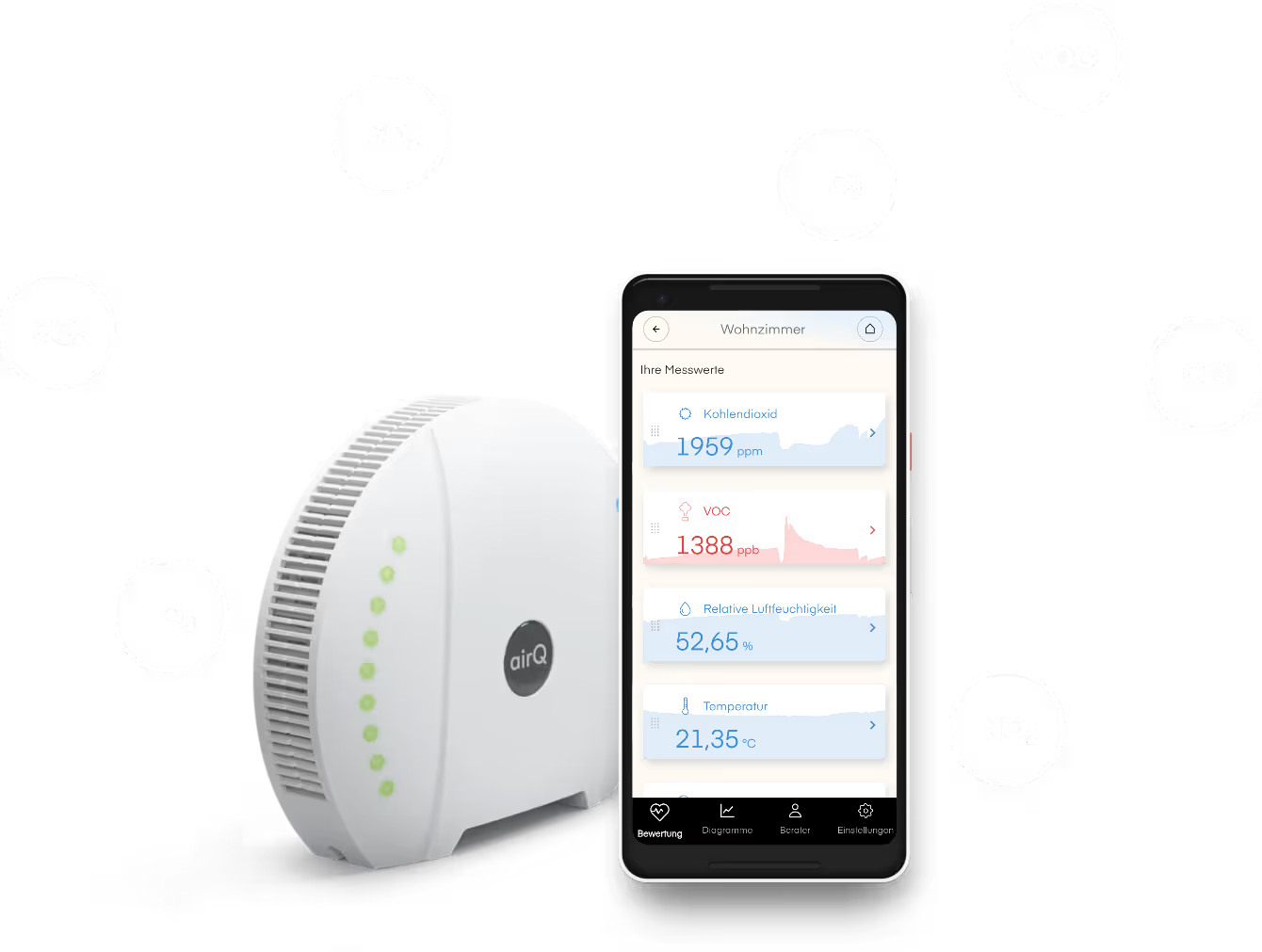
Particulate matter refers to a mixture of solid and liquid suspended particles with a very small diameter. Depending on particle size and composition, particulate matter can have a lasting impact on the respiratory tract and the cardiovascular system. The air-Q air analyzer can measure particulate matter of different particle sizes (PM₁₀, PM₂.₅, PM₁).
Chlorine / Chlorine Gas (Cl₂)
Chlorine (Cl₂) is a toxic, greenish gas with high reactivity. At low concentrations it irritates mucous membranes and the respiratory tract; at high concentrations it is corrosive.

Ammonia (NH₃)
Ammonia (NH₃) is a pungent-smelling, colorless and toxic gas. It irritates the eyes and respiratory tract and has a suffocating effect. As a raw material, ammonia is one of the most heavily produced industrial chemicals of all. In nature it occurs as a reaction product of urea and various salts.