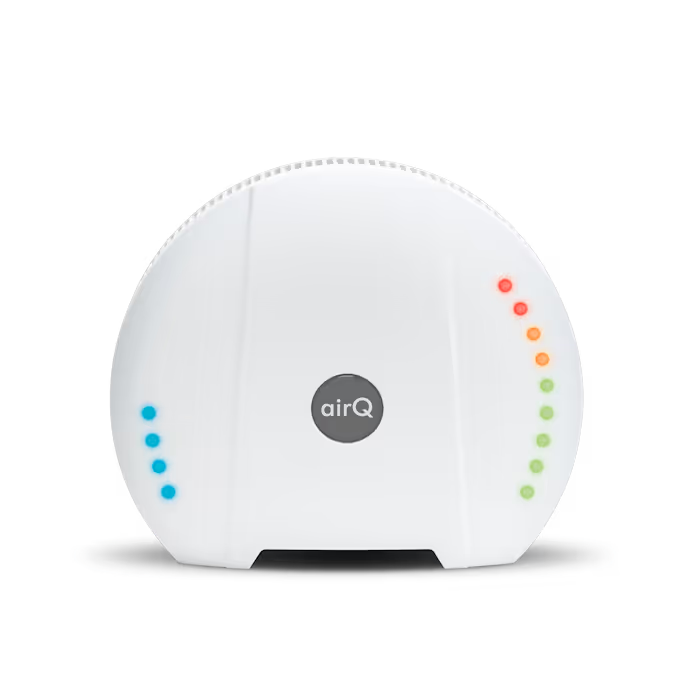
Our scientific approach to air analysis
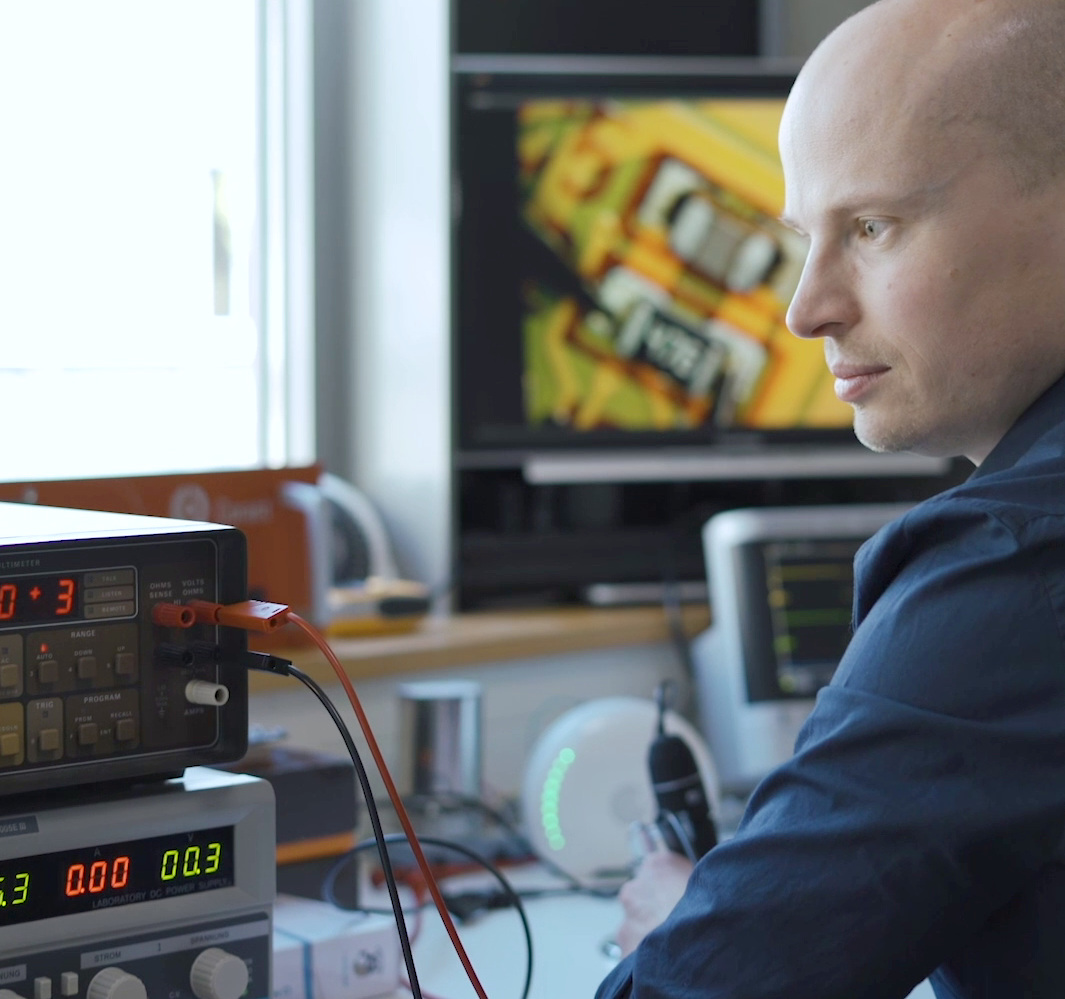
The air-Q technology has been developed since 2015 in cooperation with several scientific partners to laboratory standards. The goal was to create an indoor air monitor – the air analyser – with smart technology that measures air quality to the highest modern standards, while remaining compact and affordable.
Software algorithms even detect situations in the air that previously could only be identified through laboratory tests – making the air-Q the most comprehensive, powerful and intelligent air quality analyser, Made in Germany.
Technical Specifications
air-Q Series
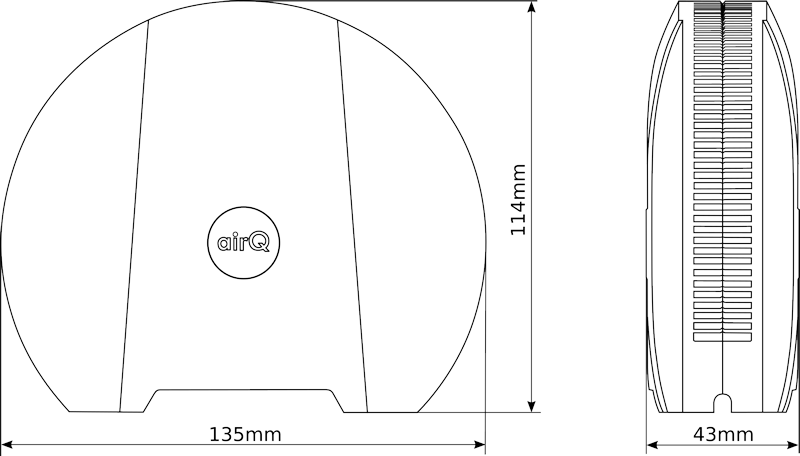
- Dimensions
- 114 × 135 × 43 mm
- Operating conditions
- Temperature 0 to +50 °C Humidity 0 – 95 %
- Interfaces
- WLAN
- Measurement interval
- 1.8 seconds in continuous operation
- Possible sensors
- Oxygen (O₂), Carbon dioxide (CO₂), Carbon monoxide (CO), Nitrogen dioxide (NO₂), Sulphur dioxide (SO₂), Ozone (O₃), Formaldehyde [specific], VOC (Volatile organic compounds as a group), Particle sizes PM₁, PM₂.₅ and PM₁₀, Temperature, relative + absolute humidity, Air pressure, Noise level
- Additional sensors (selection)
- Hydrogen sulphide (H₂S), Ammonia (NH₃), Methane (CH₄), Hydrogen (H₂), Butane (C₄H₁₀), Illuminance/light sensor
- Storage
- 16 GB Micro-SD for approx. 10 years of data
- Power supply
- 5 V USB power adapter USB-A to USB-C, optional battery (e.g. USB powerbank)
air-Q Radon Series
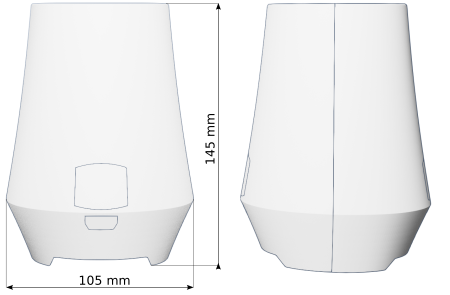
- Dimensions
- 145 × 105 × 105 mm
- Operating conditions
- Temperature 0 to +50 °C Humidity 15 – 95 %
- Interfaces
- WLAN
- Measurement interval
- 1.8 seconds in continuous operation
- Possible sensors
- Radon (dedicated measurement module), Carbon dioxide (CO₂), VOC (Volatile organic compounds as a group), Particle sizes PM₁, PM₂.₅, PM₄ and PM₁₀, Particle count, Temperature, relative + absolute humidity, Air pressure
- Storage
- 16 GB Micro-SD for approx. 10 years of data
- Power supply
- 5 V USB power adapter USB-A to USB-C, optional battery (e.g. USB powerbank)

Our Measurement Parameters / Sensors:

Hydrogen (H₂)
Hydrogen only occurs stably as molecular hydrogen (H₂) and is a colorless and odorless gas. It reacts quickly with oxygen (O₂) to form water, releasing energy in the process. H₂ is non-toxic but has flammable/explosive properties.

Volatile Organic Compounds (VOC)
VOCs (Volatile Organic Compounds) are organic, carbon-containing compounds that evaporate even at low temperatures. In many cases, VOCs are largely harmless to living organisms — despite affecting well-being. However, this group of substances also includes health-critical compounds such as formaldehyde.

Air Temperature (T)
Air temperature has a significant influence on the reaction rate of chemical processes and therefore on the human metabolic process. Measuring it is therefore worthwhile. Temperatures that are too high or too low can negatively affect both mental and physical health.

Dew Point (Td)
The dew point describes the temperature at which relative humidity reaches 100% and the water vapor present in the air would immediately begin to condense into water.

Nitrogen Dioxide (NO₂)
Nitrogen dioxide (NO₂) belongs to the group of nitrogen oxides. It is a reddish-brown gas with a pungent odor similar to chlorine. NO₂ has a strongly irritating effect on the respiratory tract and promotes asthma.

Hydrogen Sulfide (H₂S)
Hydrogen sulfide is a colorless, foul-smelling, and highly toxic gas that is combustible and readily flammable. It has the characteristic odor of rotten eggs and forms when proteins from sulfur-containing amino acids are broken down by putrefactive and sulfur bacteria.

Sulfur Dioxide (SO₂)
Sulfur dioxide is a colorless irritant gas with a pungent smell and sour taste, perceptible to humans at a concentration between 0.8 and 4.0 mg/m³.

Oxygen (O₂)
Molecular oxygen (O₂) is a colorless and odorless gas that makes up 21% of the air. On the Earth's surface, oxygen is – by mass – the most abundant element.

Radon (Rn)
Radon is a noble gas whose decay releases radioactive particles (known as alpha radiation).

Ozone (O₃)
Ozone (O₃) near the ground forms through the reaction of oxygen, nitrogen oxides, and volatile organic compounds under intense sunlight. Even slightly elevated concentrations cause strong irritation of the mucous membranes and respiratory tract.

Methane (CH₄)
Methane is a flammable gas and the main component of heating gas.

Relative Humidity (ρ)
Humidity refers to the proportion of water vapor in the gas mixture of the air. Excessively high or low humidity indoors can negatively affect human well-being and health.

Absolute Humidity (φ)
Absolute humidity describes water vapor density: the mass of water vapor contained in a defined volume of air.

Air Pressure (p)
Air pressure results from the continuous movement of air masses. As part of the atmospheric environmental conditions, it directly affects human health and well-being.

Light / Illuminance (lx)
The light sensor measures light intensity by detecting the brightness of incoming light and converting it into a digital signal. It only takes into account the light spectrum visible to the human eye and ignores infrared and ultraviolet radiation.

Noise Peak Level (Lp_max)
Unlike the ongoing "normal" noise value, the noise peak value reflects acute noise events — such as a short loud bang at night. These events, documented by the noise peak value, can abruptly interrupt rest periods and cause stress.

Noise (Lp)
Sound becomes noise when unwanted sounds are perceived as disturbing, annoying or impairing. As a psychosocial stress factor, noise can significantly impair well-being and performance.

Nitrous Oxide (Dinitrogen Monoxide) (N₂O)
Dinitrogen monoxide is a colorless, tasteless gas with a slightly sweetish odor. Known as nitrous oxide, it is best known in medicine as a pain-relieving and anesthetic agent.

Carbon Monoxide (CO)
Carbon monoxide (CO) is formed, among other things, by the incomplete combustion of carbon-containing substances. The colorless, odorless and tasteless gas is a potent respiratory poison that quickly reaches dangerous concentrations in unventilated rooms.

Carbon Dioxide (CO₂)
Carbon dioxide (CO₂) is one of the natural components of air and an important greenhouse gas in the Earth's atmosphere. Excessive carbon dioxide concentrations indoors lead to reduced performance and fatigue, up to life-threatening shortness of breath.

Formaldehyde (CH₂O)
Formaldehyde is a colorless, pungent-smelling substance that is gaseous at room temperature. Due to its use in adhesives, formaldehyde is now very widespread indoors and is found in many wood-based materials and furniture.

Particulate Matter (PM₁ – PM₂.₅ – PM₁₀)
Particulate matter refers to a mixture of solid and liquid suspended particles with a very small diameter. Depending on particle size and composition, particulate matter can have a lasting impact on the respiratory tract and the cardiovascular system. The air-Q air analyzer can measure particulate matter of different particle sizes (PM₁₀, PM₂.₅, PM₁).
Chlorine / Chlorine Gas (Cl₂)
Chlorine (Cl₂) is a toxic, greenish gas with high reactivity. At low concentrations it irritates mucous membranes and the respiratory tract; at high concentrations it is corrosive.

Ammonia (NH₃)
Ammonia (NH₃) is a pungent-smelling, colorless and toxic gas. It irritates the eyes and respiratory tract and has a suffocating effect. As a raw material, ammonia is one of the most heavily produced industrial chemicals of all. In nature it occurs as a reaction product of urea and various salts.
Know about all the gases and particles in the air you breathe.

The air-Q features a comprehensive database of all relevant gases and particles in the air we breathe – such as carbon dioxide, nitrogen dioxide, sulphur dioxide, fine particulate matter and others. It contains the sources and causes of specific air pollution, the effects on the human body and all current limit values. This data is also used to calculate the health index and performance index.
Health Index and Performance Index™
The air-Q Health Index and the air-Q Performance Index provide a quick overview of air quality in your home or office. The indices are continuously calculated based on current official air quality limit values and displayed on the air-Q device and in the app.

air-Q Health Index

air-Q Performance Index
Incorporating official recommendations and limit values
The air-Q provides tips based on official limit values and recommendations. Guidelines from the Federal Environment Agency and the WHO are used and applied continuously in the calculation of the air-Q Health Index.



Online/Offline
air-Q can connect to your local Wi-Fi network or open its own Wi-Fi hotspot. This gives you direct access to your air analyses wherever you are.

Digitally connected in Smart Home
Supported: IFTTT, Alexa, Homebridge for Apple HomeKit, openHAB, Homey and other Smart Home standards. Google Assistant and more coming soon.

Data storage
air-Q archives all recorded data on its internal storage (SD card) for over ten years. A data export (as CSV) is possible.

Data security
All data stays with you. Nothing goes to the cloud or third-party servers unless you explicitly wish it. You remain in control of your data.

Cloud services
If needed, you can access all air analysis data via our cloud. This allows you to check air quality in your living or working spaces from anywhere – on PC or smartphone.

API interface
air-Q offers API interfaces through which all data can also be retrieved / transmitted in third-party software.

Accuracy
In continuous operation, air-Q's high-precision sensors capture all air and environmental data every second.

Longevity
The sensors in air-Q were selected for optimal durability. They are based on optical or electrochemical measurement principles and measure for 5 to 10 years.

Sustainability
Our electrochemical sensors have a high minimum lifespan of 5 to 10 years. After this period, you can have individual components replaced by us and continue using the device.

Expandability
air-Q has a base with an additional free slot for another individually selectable sensor, enabling highly customised measurement requirements.
Certified Quality

The WELL standard is an international rating system for building certification, developed and regulated by the Well Building Institute (IWBI) in the USA. It is the first standard of its kind to focus exclusively on the health and well-being of people in buildings. The air-Q meets the high standards WELL requires for air quality measurement and is certified by IWBI.
Our partners in sensor development
Together with many partners, we develop the air-Q air analyser and the air-Q app to improve the health and performance of people. Particularly important are our development partners, with whom we work daily on new solutions for healthy and conscious breathing and living.