
ESRS and Indoor Air Quality: Why Air Quality Matters for ESG and Occupational Health and Safety
What role does indoor air quality play under the ESRS? Find out why air quality, occupational health and safety, employee health and ESG are closely linked.

ESRS: What companies need to know
The European Sustainability Reporting Standards (ESRS) set out the requirements of European sustainability reporting in detail. While the CSRD provides the legal framework, the ESRS specify which topics, metrics and information companies should cover in their sustainability reporting.
The standards cover environmental, social and governance (ESG) topics. These include, for example, climate change mitigation, pollution, working conditions, health and safety, and aspects of corporate governance.
For companies, this means that sustainability should not merely be described, but presented in a transparent, structured and, wherever possible, data-driven way.
One important principle applies: not every topic is automatically subject to reporting for every company. What counts are the topics classified as material in the materiality assessment. That is exactly why it is worth asking what role indoor air quality can play in the context of ESG, occupational health and safety, and the ESRS.
Why indoor air quality can be relevant to ESG and sustainability strategies
Indoor air quality affects millions of people every day in offices, schools, clinics, hotels and other buildings. Yet it often remains invisible.
Elevated CO₂ levels, volatile organic compounds (VOCs), particulate matter and unfavorable humidity can affect well-being, concentration and the perceived quality of work environments. Companies are therefore paying increasing attention to how indoor air quality can be systematically measured and improved.
This topic is becoming especially important in the ESG context. After all, sustainability covers not only environmental aspects but also responsibility towards a company’s own employees. A healthy work environment, prevention and occupational health and safety are core elements of modern ESG strategies.
Indoor air quality can help companies assess work environments on the basis of data, identify risks early and implement improvements in a traceable way. This gives companies an additional basis for making better-informed decisions on health, safety and building management.

ESRS S1 and ESRS E2: What is the difference?
When it comes to indoor air quality, two ESRS standards frequently come up: ESRS S1 and ESRS E2. Both can relate to air quality, but they pursue different objectives.
ESRS S1: Own workforce
ESRS S1 deals with a company’s own workforce. Its topics include:
- Working conditions
- Health and safety
- Occupational health and safety
- Equal opportunities
- Well-being at work
The focus is on the people in the company and on how work environments are designed.
ESRS E2: Pollution
ESRS E2 addresses pollution. This includes, for example:
- Air pollution
- Water pollution
- Soil pollution
- Release of pollutants
The central question here is what impact a company has on the environment and how that impact is managed.
In short:
ESRS S1 asks: How do working conditions affect employees?
ESRS E2 asks: How do business activities contribute to pollution?
Why air-Q fits ESRS S1 better than ESRS E2
The air-Q measures indoor air quality in offices, meeting rooms, schools, clinics, hotels and other buildings. Depending on the model, it continuously records parameters such as CO₂, VOCs, particulate matter, temperature, humidity and other indoor air values.
This data helps companies better understand air quality in the workplace and track trends over longer periods.
That is precisely why there is a particularly strong link to ESRS S1. The measured data can help make work environments more transparent and support decisions on health, safety and prevention.
Poor indoor air quality can indicate, for example, that rooms are not adequately ventilated, that the way they are used does not match the existing ventilation, or that further investigation would be advisable. Continuous indoor air measurements provide a reliable data basis here.
One thing is important to note: air-Q does not produce sustainability reports and is not an ESRS compliance tool. However, the system can provide valuable information for ESG, HSE, facility management and occupational health and safety processes.
What air-Q can contribute in the context of ESRS S1
Making indoor air quality visible
Many workplace air quality problems go unnoticed for a long time. Rising CO₂ levels, elevated VOC concentrations or particulate pollution are often not directly perceptible. Continuous measurements make such developments visible.
Supporting prevention
Indoor air data can point to potential exposure situations. This gives companies the opportunity to respond early and consider appropriate measures.
Understanding work environments better
Every room is used differently. A meeting room behaves differently from an open-plan office or a treatment room. Indoor air measurements help analyze these differences on the basis of data.
Documenting measures traceably
Anyone who changes ventilation concepts, building services or usage processes wants to be able to track the effect of these measures. Continuous measurement data makes changes visible and comparable.
Connecting ESG, HSE and facility management
Indoor air quality is a topic that affects several areas of a company. ESG managers, occupational safety officers, HSE teams and facility managers often benefit from the same indoor air data.
Does ESRS S1 mean that companies have to measure indoor air?
No. ESRS S1 does not impose a general obligation to measure CO₂, VOCs, particulate matter or other indoor air quality parameters.
However, companies must assess and document material matters relating to the health, safety and working conditions of their employees, insofar as these are relevant to the company. Indoor air data can serve as an additional source of information. It helps companies better understand work environments and back up measures with data.
What about ESRS E2?
ESRS E2 addresses pollution and emissions. At first glance, this suggests a link to air quality. On closer inspection, however, these are different types of data. ESRS E2 is primarily concerned with emissions and releases of pollutants into the environment. air-Q, by contrast, measures concentrations inside buildings.
An example:
If elevated CO₂ levels are measured in a meeting room, this provides valuable information about air quality in the workplace. It does not, however, automatically reveal what quantities of pollutants a company emits into the environment.
This is why, in most cases, the link to ESRS S1 is considerably more direct than the link to ESRS E2.
Why indoor air quality is a strong ESG topic
Indoor air quality connects sustainability, employee health, occupational health and safety, and building management in a particularly tangible way.
Employees spend a large part of their day indoors. At the same time, companies can actively influence and improve air quality in the workplace.
This makes indoor air quality a practical ESG topic:
- Measure rooms
- Detect anomalies
- Analyze causes
- Derive measures
- Document improvements
For ESG managers, this creates an area in which data-driven decisions can be linked directly to health, prevention and the work environment.
Summary and FAQ
What are the ESRS?
What role does indoor air quality play in the ESG context?
What is the difference between ESRS S1 and ESRS E2?
How does the air-Q support companies in connection with the ESRS?
Why is indoor air quality relevant for companies?
More blog posts
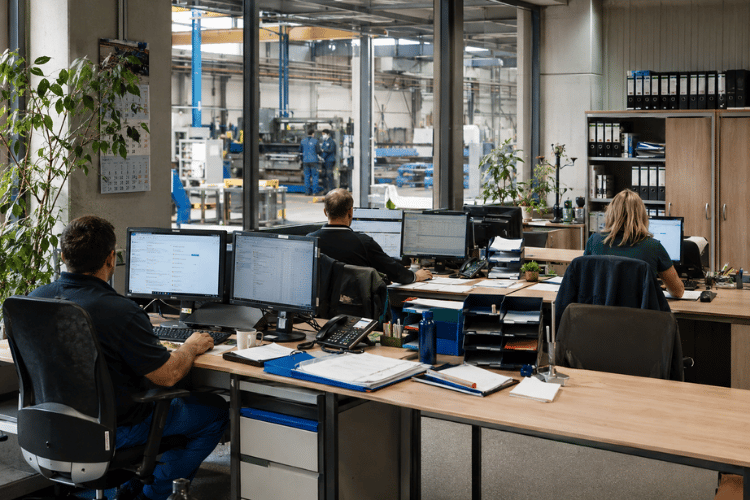
Measuring dust exposure in the workplace: continuous monitoring with air-Q
The air-Q continuously records PM1, PM2.5 and PM10 and makes dust peaks and recurring exposure patterns in the workplace visible.
Learn more
Hydrogen Fluoride: Invisible Danger in Battery Fires and Technical Facilities
Hydrogen fluoride (HF) is a highly dangerous gas that can arise, among other things, from defects or fires in lithium-ion batteries. Learn what health risks exist, what limit values apply, and why continuous monitoring with an HF sensor is important for battery storage, BESS facilities, and industrial applications.
Learn more
These Air Values Are Especially Important in Summer
In summer, not just high temperatures affect the indoor climate. CO₂, humidity, temperature, ozone, particulate matter, and VOC also affect the indoor climate — and why regular measurement makes sense for health, well-being, and performance.
Learn more