
Measuring dust exposure in the workplace: continuous monitoring with air-Q
The air-Q continuously records PM1, PM2.5 and PM10 and makes dust peaks and recurring exposure patterns in the workplace visible.
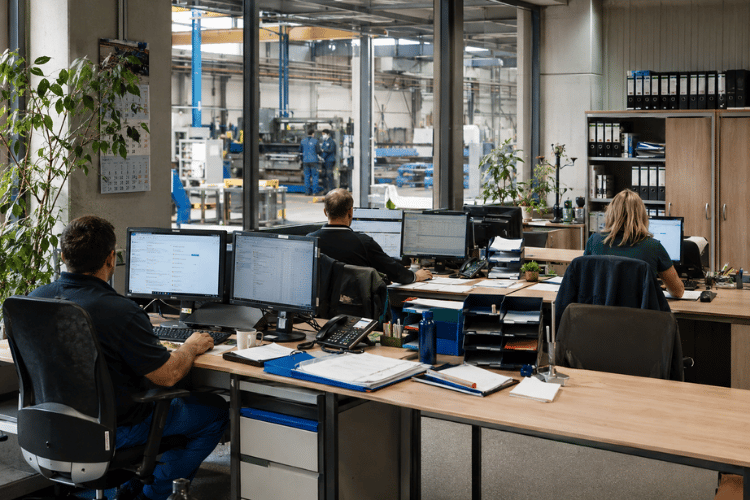
Measuring dust exposure in the workplace
In workshops, production halls and warehouses, dust is generated by activities such as grinding, drilling, sawing, decanting, packaging or cleaning. Vehicles and material handling can also stir up settled dust again.
Particle concentrations can rise sharply and fall again within a short time. A single measurement therefore only covers a limited period. Continuous dust monitoring complements workplace measurements by showing when exposure occurs, how long it lasts and whether it recurs regularly.
With the air-Q, you can continuously record and analyse particulate matter levels for PM1, PM2.5 and PM10. This makes dust peaks, exposure patterns and changes after operational measures visible.
The air-Q is suitable for indicative monitoring of particulate exposure. However, it does not replace a standard-compliant workplace measurement, because assessing compliance with occupational exposure limits requires the respirable and inhalable dust fractions (known in Germany as A-Staub and E-Staub) to be determined using suitable methods.
Why continuous monitoring makes sense
Dust exposure depends on tasks, machines, materials and ventilation conditions. A single measurement may look unremarkable even though high exposure peaks regularly occur during certain work steps.
Continuous measurement data helps you identify:
- when particulate exposure occurs,
- how long it lasts,
- whether certain processes or tasks are the cause,
- whether protective measures such as local exhaust ventilation or changed workflows are effective.
Monitoring does not replace a workplace measurement, but it can help you pinpoint conspicuous periods and areas for further investigation more precisely.
Respirable dust, inhalable dust and PM values are not the same
Occupational safety distinguishes between inhalable dust (E-Staub, the inhalable fraction) and respirable dust (A-Staub, the alveolar fraction). The inhalable fraction comprises particles that can be taken in through the mouth and nose, while the respirable fraction can penetrate as far as the alveoli of the lungs.
The PM1, PM2.5 and PM10 values familiar from general air quality measurement follow a different definition. They must therefore not be equated with respirable or inhalable dust, nor converted into one another.
Dust limits in the workplace
For poorly soluble or insoluble dusts that are not regulated otherwise, the German Technical Rule for Hazardous Substances TRGS 900 sets the following general dust limits (Arbeitsplatzgrenzwerte, AGW):
- 1.25 mg/m³ for the respirable dust fraction (A-Staub)
- 10 mg/m³ for the inhalable dust fraction (E-Staub)
Stricter requirements may apply to dusts with specific hazardous properties, for example dusts containing quartz, wood dust or carcinogenic constituents.
A low PM concentration therefore does not automatically mean that there is no hazard.
How does the air-Q measure particulate matter?
The particulate matter sensor in the air-Q uses an optical measuring principle. The particles drawn in scatter light onto a detector. Particle sizes are calculated from the measurement signals, and the mass concentrations for PM1, PM2.5 and PM10 are derived from them.
This method allows fast, continuous observation of particulate levels. Unlike a gravimetric measurement, however, the dust mass is not weighed directly.
The readings can be affected by particle properties such as shape, density or colour, as well as by high humidity, very high dust concentrations or deposits in the sensor. In dust-intensive applications, the measuring range, device condition and positioning should therefore be checked regularly.
An air quality monitor therefore serves as an indicator of changes in particulate exposure, not as a legally binding assessment of personal dust exposure.
Identifying dust sources and processes
The advantage of continuous monitoring lies in linking readings to operational processes. If particulate matter levels regularly rise during certain tasks, possible causes are easier to identify.
It is helpful to document:
- dust-generating tasks,
- the machines and materials used,
- ventilation and local exhaust,
- cleaning work,
- vehicle and material movements,
- maintenance work or malfunctions.
This helps companies better understand when dust exposure occurs and which processes are linked to it.
Checking protective measures
When local exhaust systems are optimised, machines are enclosed or workflows are changed, the air-Q can make changes in particulate levels visible.
For example, you can check:
- whether dust peaks are lower,
- whether the duration of exposure changes,
- whether measures remain effective at higher workloads.
For meaningful comparisons, measurement conditions such as device position, task and material should remain as constant as possible. Whether a protective measure meets the requirements of hazardous substances legislation must be assessed by a qualified expert.
Typical areas of application
Continuous particulate monitoring with the air-Q is particularly suitable for areas where particles are regularly released or stirred up, for example:
- workshops and manufacturing areas
- production and assembly halls
- warehouse and logistics areas
- filling and packaging lines
- training workshops
- areas where materials are processed
- workplaces handling powdered substances
- areas with frequent cleaning work
In large halls or halls used for different purposes, a single measuring point cannot represent every area. Several devices can help to identify spatial differences and possible dispersion paths.
Using continuous data in occupational safety
The air-Q complements professional workplace measurements with continuous insight into how particulate levels develop over time.
This enables companies to:
- detect dust events,
- narrow down the causes of exposure,
- observe processes over longer periods,
- compare protective measures,
- plan further investigations in a more targeted way.
The air-Q is thus a tool for detecting changes and anomalies early, but not a device for measuring compliance with exposure limits.
Conclusion
In everyday work, dust exposure changes depending on the task, process and environment. Individual measurements are important for a professional assessment, but they only cover a limited period.
The air-Q makes the development of PM1, PM2.5 and PM10 over time visible and helps you trace dust peaks, recurring patterns and changes after measures have been taken.
The air-Q cannot replace a standard-compliant measurement of respirable or inhalable dust or the assessment of occupational exposure limits. As a complementary monitoring system, however, it provides transparency about the development of particulate exposure in dust-intensive work areas.
Summary and FAQ
How can particulate matter levels be measured in the workplace?
What are the benefits of continuous dust monitoring?
Can protective measures be checked with the air-Q?
Are PM2.5 and respirable dust the same thing?
Where can the air-Q readings be used?
More blog posts
Hydrogen Fluoride: Invisible Danger in Battery Fires and Technical Facilities
Hydrogen fluoride (HF) is a highly dangerous gas that can arise, among other things, from defects or fires in lithium-ion batteries. Learn what health risks exist, what limit values apply, and why continuous monitoring with an HF sensor is important for battery storage, BESS facilities, and industrial applications.
Learn more
These Air Values Are Especially Important in Summer
In summer, not just high temperatures affect the indoor climate. CO₂, humidity, temperature, ozone, particulate matter, and VOC also affect the indoor climate — and why regular measurement makes sense for health, well-being, and performance.
Learn more
How CO₂ Affects Cognitive Performance
High CO₂ concentrations indoors can impair concentration, attention, and decision-making ability. Learn why CO₂ is an important indicator of indoor air quality and how the air-Q helps make air quality visible and specifically improve it.
Learn more