


air-Q pro - The Professional for Ambitious Users
- Carbon Dioxide
- Volatile Organic Compounds
- Relative Humidity
- Air Temperature
- Noise
- Particulate Matter
- Carbon Monoxide
- Nitrogen Dioxide
- Air Pressure
- Formaldehyde
- Ozone
With more than 13 sensors, you monitor the air for toxins and hazards. Dangerous situations like smoke and fire can be detected significantly earlier.


We spend a large part of our time indoors. There are many possible sources of pollutants and accompanying substances that can be present in the air there. With the air-Q, you can really measure every gas and aerosol that can occur. This lets you find the causes and uncover the sources. The analyses often bring exciting and sometimes surprising things to light.
No one offers more sensors than the air-Q! With 14 dedicated sensors plus an additional sensor (air-Q Science), the air-Q measures everything that can occur in the air. Additional "virtual sensors" currently expand the device by two calculated readings (e.g. the dew point). Through regular software updates, more virtual sensors will be added, which use the properties of the hardware-integrated sensors to gain additional information.

Hydrogen only occurs stably as molecular hydrogen (H₂) and is a colorless and odorless gas. It reacts quickly with oxygen (O₂) to form water, releasing energy in the process. H₂ is non-toxic but has flammable/explosive properties.

VOCs (Volatile Organic Compounds) are organic, carbon-containing compounds that evaporate even at low temperatures. In many cases, VOCs are largely harmless to living organisms — despite affecting well-being. However, this group of substances also includes health-critical compounds such as formaldehyde.

Air temperature has a significant influence on the reaction rate of chemical processes and therefore on the human metabolic process. Measuring it is therefore worthwhile. Temperatures that are too high or too low can negatively affect both mental and physical health.

The dew point describes the temperature at which relative humidity reaches 100% and the water vapor present in the air would immediately begin to condense into water.

Nitrogen dioxide (NO₂) belongs to the group of nitrogen oxides. It is a reddish-brown gas with a pungent odor similar to chlorine. NO₂ has a strongly irritating effect on the respiratory tract and promotes asthma.

Hydrogen sulfide is a colorless, foul-smelling, and highly toxic gas that is combustible and readily flammable. It has the characteristic odor of rotten eggs and forms when proteins from sulfur-containing amino acids are broken down by putrefactive and sulfur bacteria.

Sulfur dioxide is a colorless irritant gas with a pungent smell and sour taste, perceptible to humans at a concentration between 0.8 and 4.0 mg/m³.

Molecular oxygen (O₂) is a colorless and odorless gas that makes up 21% of the air. On the Earth's surface, oxygen is – by mass – the most abundant element.

Radon is a noble gas whose decay releases radioactive particles (known as alpha radiation).

Ozone (O₃) near the ground forms through the reaction of oxygen, nitrogen oxides, and volatile organic compounds under intense sunlight. Even slightly elevated concentrations cause strong irritation of the mucous membranes and respiratory tract.

Methane is a flammable gas and the main component of heating gas.

Humidity refers to the proportion of water vapor in the gas mixture of the air. Excessively high or low humidity indoors can negatively affect human well-being and health.

Absolute humidity describes water vapor density: the mass of water vapor contained in a defined volume of air.

Air pressure results from the continuous movement of air masses. As part of the atmospheric environmental conditions, it directly affects human health and well-being.

The light sensor measures light intensity by detecting the brightness of incoming light and converting it into a digital signal. It only takes into account the light spectrum visible to the human eye and ignores infrared and ultraviolet radiation.

Unlike the ongoing "normal" noise value, the noise peak value reflects acute noise events — such as a short loud bang at night. These events, documented by the noise peak value, can abruptly interrupt rest periods and cause stress.

Sound becomes noise when unwanted sounds are perceived as disturbing, annoying or impairing. As a psychosocial stress factor, noise can significantly impair well-being and performance.

Dinitrogen monoxide is a colorless, tasteless gas with a slightly sweetish odor. Known as nitrous oxide, it is best known in medicine as a pain-relieving and anesthetic agent.

Carbon monoxide (CO) is formed, among other things, by the incomplete combustion of carbon-containing substances. The colorless, odorless and tasteless gas is a potent respiratory poison that quickly reaches dangerous concentrations in unventilated rooms.

Carbon dioxide (CO₂) is one of the natural components of air and an important greenhouse gas in the Earth's atmosphere. Excessive carbon dioxide concentrations indoors lead to reduced performance and fatigue, up to life-threatening shortness of breath.

Formaldehyde is a colorless, pungent-smelling substance that is gaseous at room temperature. Due to its use in adhesives, formaldehyde is now very widespread indoors and is found in many wood-based materials and furniture.

Particulate matter refers to a mixture of solid and liquid suspended particles with a very small diameter. Depending on particle size and composition, particulate matter can have a lasting impact on the respiratory tract and the cardiovascular system. The air-Q air analyzer can measure particulate matter of different particle sizes (PM₁₀, PM₂.₅, PM₁).
Chlorine (Cl₂) is a toxic, greenish gas with high reactivity. At low concentrations it irritates mucous membranes and the respiratory tract; at high concentrations it is corrosive.

Ammonia (NH₃) is a pungent-smelling, colorless and toxic gas. It irritates the eyes and respiratory tract and has a suffocating effect. As a raw material, ammonia is one of the most heavily produced industrial chemicals of all. In nature it occurs as a reaction product of urea and various salts.
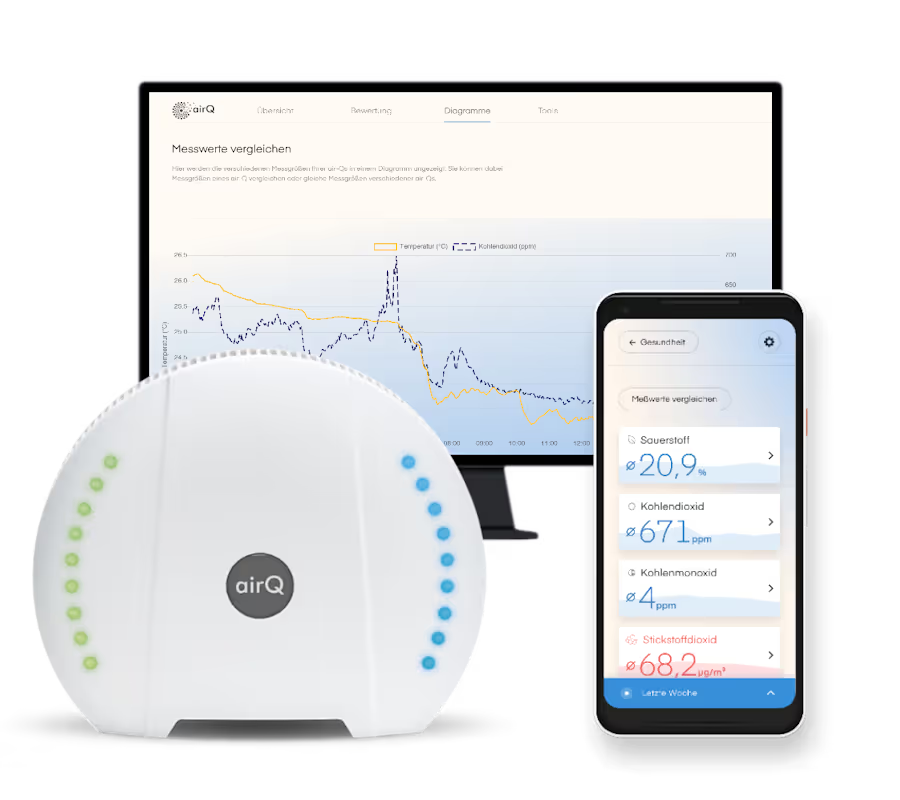
All measured values can be viewed and analyzed via the air-Q Smartphone App Nothing goes undetected, since the sensors used in the air-Q measure with a sampling rate of under two seconds — truly in real time. The air-Q is also networkable and works with common smart home standards. Thanks to open data interfaces, there are no limits to deeper analyses of your own or connections into your smart home.
