
Wildfire Smoke Indoors: How to Protect Your Indoor Air
Wildfire smoke can bring particulate matter and other pollutants into buildings. Find out how to monitor your indoor air, keep a room as clean as possible and check whether your measures work with the air-Q.
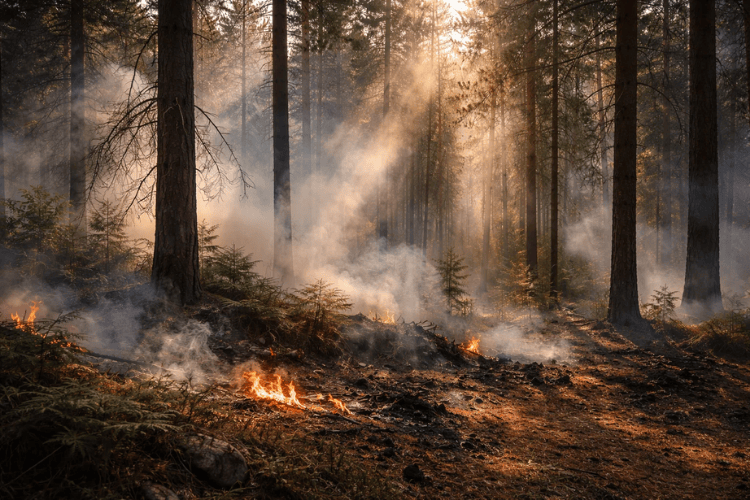
Wildfires endanger more than the people and buildings close to the flames. Their smoke can affect entire regions for days or weeks. Depending on wind and weather, air quality also deteriorates far outside the actual danger zone.
During such smoke events, many people retreat indoors and close their windows and doors. That makes sense in principle, but it does not automatically keep the indoor air clean. Smoke particles can get in through leaky windows and doors, ventilation systems and other openings in the building. How high the exposure actually is depends on the building, how long the event lasts and how the rooms are ventilated, among other things.
Continuous indoor air monitoring helps to detect this invisible exposure and to target protective measures.
Which pollutants does wildfire smoke contain?
Wildfire smoke is a complex mixture of gases and particles. Which substances form depends on what is burning (vegetation, buildings, vehicles or other materials) and how complete the combustion is.
For health, fine particulate matter matters most. Very small particles can stay airborne for a long time and penetrate deep into the airways. The World Health Organization considers particulate matter the greatest health hazard in the wildfire smoke mixture.
Key measurands are:
- PM1 and PM2.5: very small particles that can reach deep into the lungs
- PM10: larger inhalable particles, including ash and stirred-up dust
- VOC: volatile organic compounds, which can be released when different materials burn
- Carbon monoxide: a toxic combustion gas that can be relevant during heavy smoke and near fires in particular
Other pollutants such as polycyclic aromatic hydrocarbons can also occur in wildfire smoke. A single indoor air monitor, however, cannot analyse the entire mixture or reliably attribute individual compounds to a source.
Why is PM2.5 particularly important with wildfire smoke?
PM2.5 refers to particles with an aerodynamic diameter of 2.5 micrometres or less. Because they are so small, these respirable particles can penetrate deep into the lungs. Some of the smallest particles can even enter the bloodstream.
In the short term, wildfire smoke can irritate the eyes and airways and cause coughing, headaches or breathing difficulties. Children, older people, pregnant women and people with asthma, cardiovascular disease or other pre-existing conditions are particularly at risk.
How far can wildfire smoke travel?
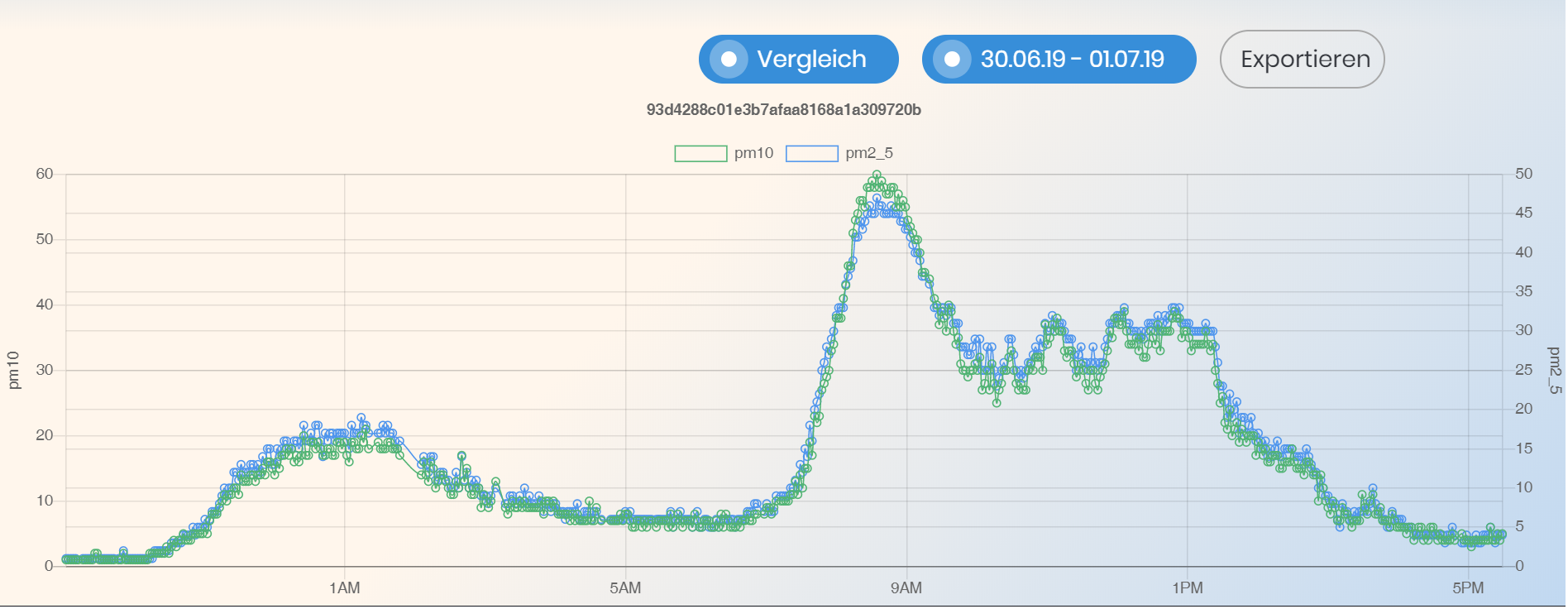
How far the wind carries air laden with particulate matter became clear at the end of June 2019, for example, when a fire broke out on a former military training area in Lübtheen (Mecklenburg-Western Pomerania). Of the 6,200 hectares of forest, between 1,200 and 1,300 hectares were affected by the fire. Overgrown forest tracks and old munitions in the ground delayed the firefighting massively, and the fire brigade spent many days containing this devastating wildfire. During that time, the fire drove the particulate matter concentration in the surrounding area up to extreme levels.
On some days, the north wind carried the wildfire particulates far inland. Even in Leipzig, around 300 kilometres from Lübtheen, the smell of burning was clearly noticeable and led to many worried calls to the fire brigade. The air-Q clearly registered the high particulate load as well: in the early hours of 1 July, it already recorded PM10 and PM2.5 values far above the daily limits of 50 µg/m³ set by the German Environment Agency (UBA) and 25 µg/m³ set by the WHO.
Particulate matter and asthma in children: what studies show
How important particulate matter can be for the development of asthma in the long term is shown by a study by Khreis and colleagues published in the European Respiratory Journal. Using population, air quality and health data, it examined the exposure of around 63.4 million children in 18 European countries.
The result of the modelling: had all the countries studied met the WHO guideline for PM2.5 in force at the time, an annual mean of 10 µg/m³, the researchers estimate that around 66,600 new asthma cases in children could have been prevented each year. That corresponded to about eleven percent of new cases. Lowering exposure to the lowest PM2.5 concentrations observed in the underlying studies, 1.5 µg/m³, would arithmetically have meant around 190,900 cases, or 33 percent.
For people who already have asthma, a period of smoke is therefore a particular risk: symptoms can get worse, medication may be needed more often and, in severe cases, hospital treatment may become necessary. Children are additionally vulnerable because their airways and immune systems are still developing.
Does wildfire smoke get into the house even with the windows closed?
Yes. Even with the windows closed, some outdoor air can get into the building. The US Environmental Protection Agency (EPA) points out that, without air cleaning, indoor PM2.5 concentrations during a smoke event often still reach a considerable share of the outdoor level. How well a building protects its occupants can, however, vary widely.
Older or leaky buildings usually let in more outdoor air than well-sealed ones. Frequently opened doors, exhaust systems and ventilation systems that draw in outdoor air also affect the exposure.
Smell and visibility are not reliable measures: indoor air can already be polluted before a distinct smell of burning is noticed. Conversely, a noticeable smell alone says nothing about the exact particulate concentration.
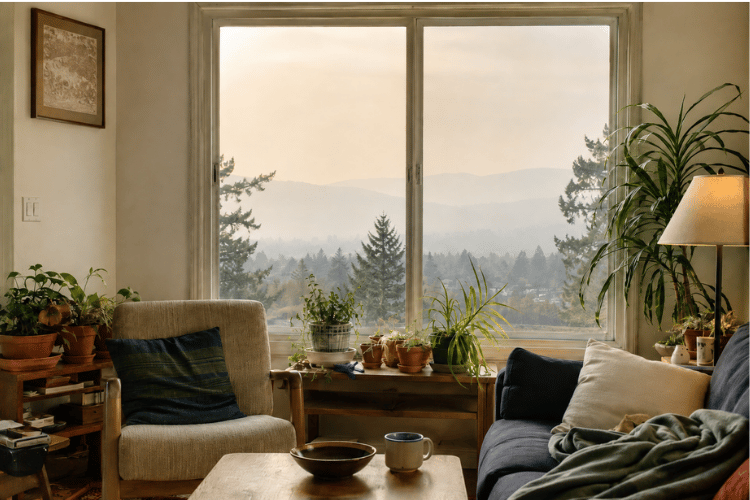
Reducing wildfire smoke indoors
If the authorities say it is safe to stay in the building, keeping one room as clean as possible can reduce personal exposure. A bedroom, for example, or another room where the occupants can stay for longer periods during the heaviest smoke, is well suited.
The following measures make sense:
1. Keep windows and doors closed
While outdoor pollution is high, windows and external doors should stay closed as far as possible. Doors should be opened only as often and as briefly as necessary.
Ventilation and air-conditioning systems can temporarily run in recirculation mode, where the system provides for it and it is safe to do so. The right setting depends on the system. Follow the instructions of the manufacturer and the competent authorities.
2. Use a suitable air purifier
An air purifier with a HEPA filter can remove a large share of the fine particles from indoor air. What matters is that the device suits the size of the room and runs long enough.
HEPA filters remove particles, but not automatically all gaseous components of the smoke. Devices with an additional, adequately sized activated carbon filter can reduce certain gaseous substances, but they do not remove every possible compound either.
3. Avoid additional sources of particles
During a smoke event, indoor air should not be burdened by further sources. These include in particular:
- smoking
- candles and incense
- wood stoves and open fireplaces
- intensive frying or grilling
- sprays and products with a high solvent content
- vacuuming without a suitable HEPA filter
Frying and candles in particular can raise particulate levels so much in the short term that the exposure is wrongly attributed to the wildfire alone.
4. Ventilate only once the outdoor air has improved
If windows stay closed for a long time, CO₂, humidity and other indoor pollutants can rise. That is why it is important to let fresh air in again at a suitable time.
Follow the announcements of local authorities and reliable outdoor air data. Once the situation has improved, short, intensive airing can make sense. Afterwards, the indoor readings show whether the particulate load has stayed low or risen again.
How does the air-Q help with wildfire smoke?
The air-Q monitors indoor air continuously. Depending on the model, it measures PM1, PM2.5 and PM10 as well as VOC, carbon monoxide, CO₂, temperature and humidity, among others.
This answers important questions:
- Is smoke getting into the building?
- Which room has the lowest particle load?
- Do the values rise when windows or doors are opened?
- How quickly does an air purifier lower the particulate concentration?
- Does the indoor air stay protected overnight?
- When do rising CO₂ levels make ventilation necessary?
The readings are shown over time, so that sustained exposure and short peaks become visible, not just individual snapshots. If values are conspicuous, the air-Q can issue warnings.
Through a smart home connection, an air purifier can also be switched on automatically, for example, as soon as the particulate load exceeds a predefined value. Whether the measure works is then visible directly in the measurement history.
Indoor air monitoring for homes, schools and businesses
Wildfire smoke does not only affect private households. Schools, care homes, hotels, offices and public buildings often have to maintain an indoor environment that is as safe as possible over longer periods.
With several networked monitors, it becomes clear which parts of a building are most affected and where filtering or sealing needs to be improved. Those responsible can document the effect of ventilation and air cleaning concepts and react faster when smoke returns.
Conclusion: measure indoors, not only outdoors
During a wildfire, staying indoors is often the most effective way to reduce personal smoke exposure, provided no evacuation is necessary. Closed windows alone, however, do not guarantee clean air.
The combination of a well-protected room, suitable air filtration, fewer indoor sources and continuous monitoring is a solid basis for lowering exposure. The air-Q shows how much smoke actually gets indoors and whether the measures taken are working.
Summary and FAQ
How does PM2.5 particulate matter affect children's health?
Which measurement matters most with wildfire smoke?
Can wildfire smoke trigger or worsen asthma?
Can the air-Q report a wildfire or a smouldering fire?
Is it enough if there is no smell of smoke in the house?
Does a HEPA filter remove all wildfire smoke?
More blog posts
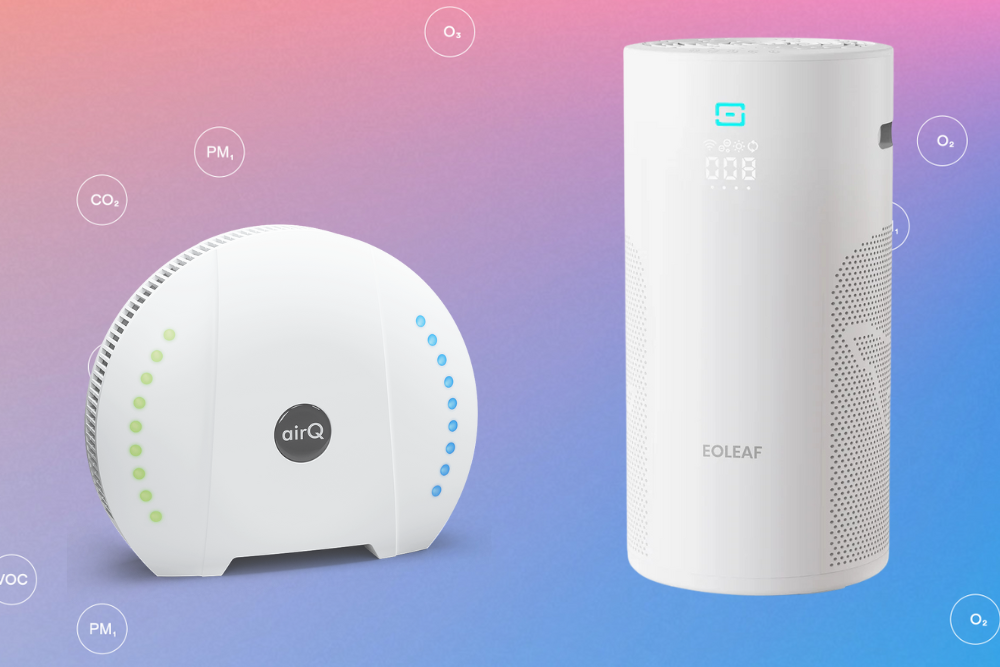
Review: How Good Is Eoleaf's NeoPur 400 Air Purifier Really?
We tested Eoleaf's NeoPur 400 air purifier. Learn here how it cleaned pollutant-laden air and how air quality changed as a result.
Learn more
The CellActivator Air Purifier by CellGenius, Hands-On Tested
Air purifiers are an effective solution for improving indoor air quality. In this article, we test the CellActivator by CellGenius, which uses so-called Light-AirIon technology. We tested with the air-Q whether the device lives up to its own ambitious claims.
Learn more
air-Q Lab: The Blueair Classic 680i Air Purifier Put to the Test
The Blueair Classic 680i air purifier promises clean indoor air – but how well does it really filter pollutants? Its effectiveness was tested in our experiment with an incense cone and deodorant. Find the results here.
Learn more