
Electrical Fires – The Underestimated Danger
For many people, it's a quiet horror scenario in the back of their mind — the electrical cable fire. It can happen at any time, and there are hardly any ways to protect against it. But what causes a cable fire, and can early signs be detected through air measurements, preventing the fire?
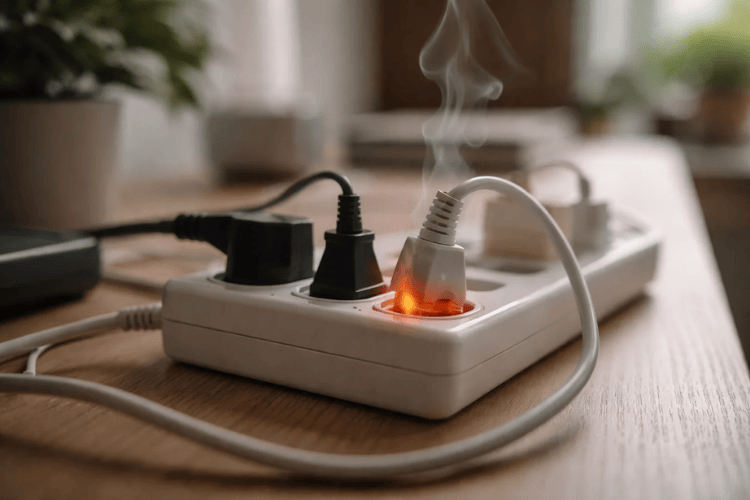
According to the Institute for Damage Prevention and Damage Research (IFS), for nearly 15 years, a third of fires have been attributable to electricity, or a cable fire. These fires often occur in private settings, since there's no mandatory regular inspection of electrical devices there, unlike in commercial settings. Smoldering fires in particular are treacherous, since they're hidden inside walls, yet still release gases, and can turn into an open fire on contact with oxygen, potentially resulting in house fires.
How does a cable fire start
A cable fire starts when there's impermissibly high heating in electrical installations or an electrical conductor, which can lead to a fire or smoldering fire, sometimes also in connection with a power outage. The usual cause is thermal overload of the conductor, resulting in excessive heating.
Causes of cable fires:
- A cable break can cause cable fires, since excessive current density arises in the corresponding section of the cable (cable cross-section too small for the flowing current). The cable then heats up strongly, damaging the insulation, which leads to short circuits and can end in a cable fire.
- Loose plug and terminal connections can also cause a cable fire, since here too the contact point is very small and can heat up strongly.
- Due to age, wiring wears down from oxidation and corrosion, which can also loosen cable connections over time. High temperatures can char the plastics used. This can produce toxic and flammable gases and vapors, which in turn can also lead to a fire.
- Power strips are often the trigger for cable fires, since they can become overloaded from connecting multiple plugs. These don't necessarily end in a fire, but they can continuously weaken power lines and their substance over a longer period. High currents thus lead to increased heat exposure, causing the lines' insulation to become brittle. This increases the risk of a smoldering fire over time, which, especially inside walls, can initially remain undetected for a long period.
- Poorly made products that don't meet common safety standards can also pose a risk factor and lead to electronics fires / cable fires.
- Lightning strikes can also cause cable fires.
Preventing cable fires
Checking insulation is helpful, since, for example, kinked or pinched cables heat up at those spots. This damages the sheathing, which can result in short circuits. Cable overload should also be avoided. This includes, among other things, fully loaded power strips or multiply branched extension cords, electric heaters, and, for example with lamps, not exceeding the stated wattage. Defective contacts and other problems like loose connections can lead to overheating and a smoldering fire, which is why such contacts should be repaired. Using a thermographic inspection, where a thermal imaging camera is used, electrical systems and installations can be examined and their surface temperature determined.
Monitoring air quality to prevent cable fires
The consequence of a cable fire can be a fatal house fire that destroys an entire home. Smoke detectors help here and save lives — for example if the fire starts at night while everyone's asleep. Smoke detectors, though, generally only trigger once the fire already exists.
It would be better to detect the fire before it even breaks out — meaning during its formation. As a cable fire develops, various typical gases are released into room air. These include, depending on the type of insulation, nitrogen dioxide, particulate matter, and VOCs. If these can be detected, an early warning would be possible.
The air-Q can already capture and detect even the smallest changes in a room's air quality. If the levels of the substances mentioned rise briefly or over a longer period, despite no other known source being present, you should respond as quickly as possible to avoid a potential fire. This makes the air-Q not just a very sensitive smoke detector and carbon monoxide detector, but also a fire prevention sensor.
Summary and FAQ
What causes a cable fire?
How can cable fires be prevented?
What dangers do cable fires pose?
How can cable fires be detected early?
More blog posts
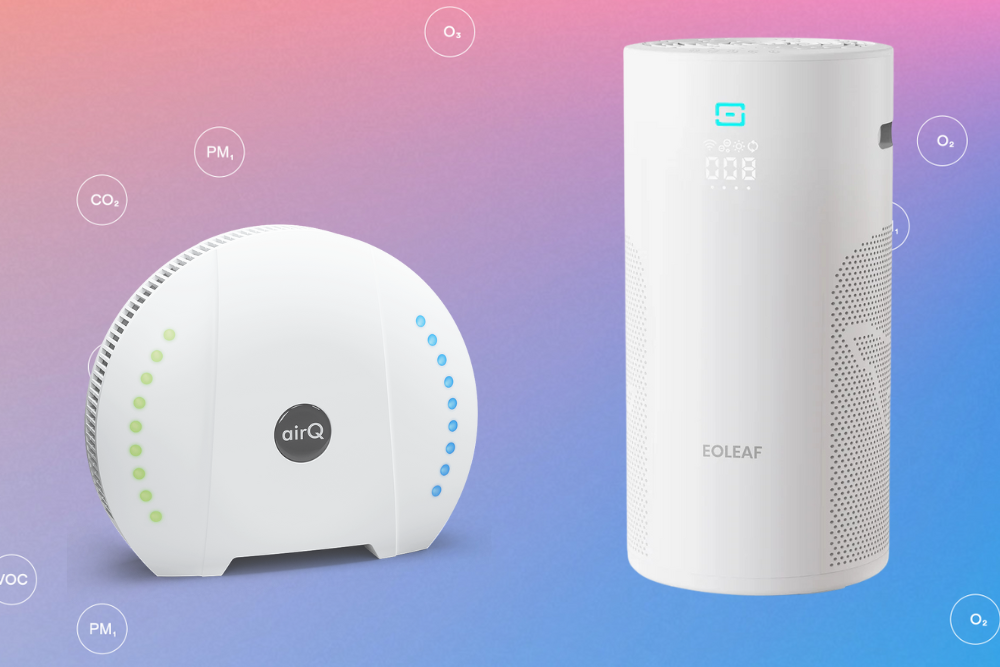
Review: How Good Is Eoleaf's NeoPur 400 Air Purifier Really?
We tested Eoleaf's NeoPur 400 air purifier. Learn here how it cleaned pollutant-laden air and how air quality changed as a result.
Learn more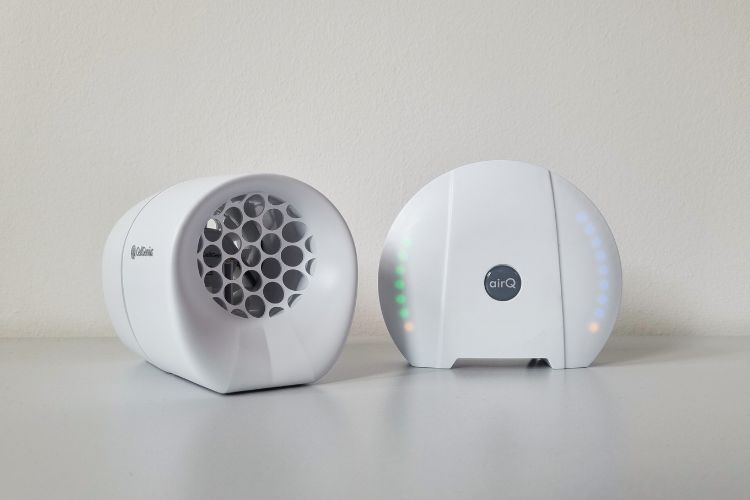
The CellActivator Air Purifier by CellGenius, Hands-On Tested
Air purifiers are an effective solution for improving indoor air quality. In this article, we test the CellActivator by CellGenius, which uses so-called Light-AirIon technology. We tested with the air-Q whether the device lives up to its own ambitious claims.
Learn more
air-Q Lab: The Blueair Classic 680i Air Purifier Put to the Test
The Blueair Classic 680i air purifier promises clean indoor air – but how well does it really filter pollutants? Its effectiveness was tested in our experiment with an incense cone and deodorant. Find the results here.
Learn more