
The CSRD explained simply: What companies need to know now and what role indoor air can play
The CSRD makes sustainability information a central reporting topic for many companies. What role do ESG data, building operations and indoor air quality play?

CSRD: Why sustainability reporting is becoming more important for companies
With the Corporate Sustainability Reporting Directive (CSRD), the European Union is fundamentally changing the requirements for corporate sustainability reporting.
The aim of the CSRD is to make sustainability information more transparent, more comparable and more verifiable. Companies are expected not only to report on financial metrics, but also to disclose how their business activities affect the environment, society and corporate governance.
This is based on the European Sustainability Reporting Standards (ESRS), which specify what information companies must collect and publish.
For many companies, this means integrating sustainability much more deeply into existing processes, responsibilities and data systems.
What does the CSRD mean for companies in practice?
The CSRD significantly expands the previous non-financial reporting. Depending on company size and regulatory scope, companies will have to systematically collect and document sustainability information and publish it in their management report.
The key questions include:
- What impact does the company have on the environment and society?
- Which sustainability risks could affect the company's performance?
- Which targets and measures have been defined?
- Which metrics document progress or the need for action?
- How robust and traceable is the underlying data?
The focus is increasingly on measurable information. Sustainability targets must be backed by robust data and traceable processes.

Why ESG data is becoming more important
With the CSRD, high-quality ESG data is gaining in importance.
In future, companies will need to demonstrate more clearly how they manage, monitor and improve sustainability aspects. This requires data from a wide range of areas: energy consumption, emissions, supply chains, occupational health and safety, building management, and health and safety measures.
The better companies capture their relevant data, the more soundly they can assess sustainability risks and document progress.
Information from building operations is also becoming more important, because buildings have a direct impact on energy consumption, resource use, working conditions and employee well-being.
Does the CSRD require indoor air to be measured?
No.
The CSRD contains no general obligation to measure indoor air quality. There are neither specific reporting requirements nor defined limit values for CO₂, VOCs, particulate matter or other air quality parameters under the CSRD.
Nor does indoor air monitoring replace sustainability consulting or legal and regulatory reviews.
Nevertheless, air quality data can be relevant for companies that want to assess sustainability, working conditions, health management or building operations on the basis of data.
Why indoor air quality can matter for ESG and sustainability strategies
People spend most of their working day indoors. Accordingly, the quality of indoor air influences how working environments are perceived, as well as aspects of building operations.
Relevant parameters include:
- CO₂ concentrations
- Humidity
- Temperature
- Particulate matter levels
- Volatile organic compounds (VOCs)
- Ventilation quality
This data can help companies understand their buildings better and identify potential for optimisation.
Especially in modern office buildings, educational institutions, healthcare facilities and administrative buildings, air quality data is increasingly seen as part of data-driven building management.
Indoor air data as a building block for building operations and ESG
Collecting indoor air data can support various areas of a company:
Health and safety
Air quality data can point to possible exposure situations and support measures to improve the working environment.
Facility management
Measurements allow a better assessment of ventilation concepts, room usage and building services.
Sustainability management
Indoor air data can provide additional information for internal analyses and sustainability programmes.
ESG communication
Companies can voluntarily document how they monitor and improve their working environments.
How air-Q supports companies
air-Q is a professional system for the continuous measurement of indoor air quality.
The system records various air quality parameters in real time and makes the data available for analysis, monitoring and integrations.
Typical areas of application are:
- Office and administrative buildings
- Educational institutions
- Healthcare facilities
- Hotels and hospitality
- Commercial and industrial properties
The data obtained can help companies make indoor air quality transparent, identify potential for optimisation and make well-founded decisions in building operations.
Why the topic is gaining importance right now
The CSRD is representative of a broader trend: sustainability is increasingly expected to be measurable, traceable and managed on the basis of data.
Even companies that are not yet directly subject to reporting requirements are facing growing expectations from customers, investors, employees and business partners.
Topics that were often only considered qualitatively are gaining in importance. These include working conditions, health protection, building operations and the quality of indoor spaces.
In this context, indoor air quality is a particularly tangible factor: it can be measured, analysed and improved through concrete measures.
Conclusion: The CSRD increases the need for robust sustainability data
The CSRD requires many companies to systematically collect sustainability information and report it transparently.
Indoor air quality is not a CSRD reporting requirement in its own right. In the context of ESG, occupational health and safety, health management and building operations, however, air quality data can make a valuable contribution to data-driven decisions.
air-Q helps companies to continuously record and evaluate this information. Not as a CSRD compliance solution, but as a professional system for measuring and analysing indoor air quality.
Summary and FAQ
What is the CSRD?
Which companies are affected by the CSRD?
What data is needed for the CSRD?
What role can indoor air play in an ESG context?
More blog posts
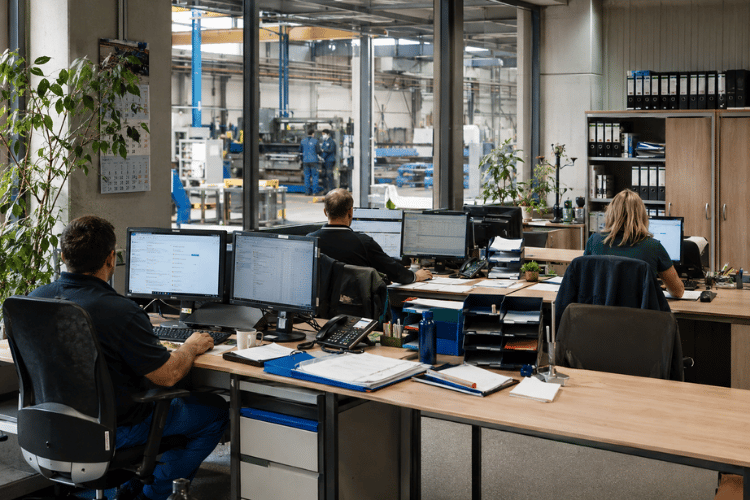
Measuring dust exposure in the workplace: continuous monitoring with air-Q
The air-Q continuously records PM1, PM2.5 and PM10 and makes dust peaks and recurring exposure patterns in the workplace visible.
Learn more
Hydrogen Fluoride: Invisible Danger in Battery Fires and Technical Facilities
Hydrogen fluoride (HF) is a highly dangerous gas that can arise, among other things, from defects or fires in lithium-ion batteries. Learn what health risks exist, what limit values apply, and why continuous monitoring with an HF sensor is important for battery storage, BESS facilities, and industrial applications.
Learn more
These Air Values Are Especially Important in Summer
In summer, not just high temperatures affect the indoor climate. CO₂, humidity, temperature, ozone, particulate matter, and VOC also affect the indoor climate — and why regular measurement makes sense for health, well-being, and performance.
Learn more